Alaskan Adventure: Days 33-36. We have been driving every day since starting on the Alaskan Highway in Dawson Creek. It was nice to finally stop for 3 nights in Whitehorse. It was also really wonderful to have sunshine and no mosquitoes!


We stopped for a hike to see some waterfalls at Rancheria Falls Recreation Area. Did not hike because the wood boardwalk was broke down and… mosquitoes. Took a pic of flowers and went on.

Views along the Alaskan Highway are beautiful.

View from our campsite in Teslin, YT. There were several great things about this stop. It stopped raining and the sun came out, and there were only a few mosquitoes around! Much more enjoyable to be outside. This campground was called Teslin Motel & RV Park situated along the Teslin Lake and Nisutlin Bay. This looks like a lake but it’s the bay of the Nisutlin River as it levels and widens out into a big delta coming into Teslin Lake. Teslin Lake is like an enormous “finger lake” at 78 miles long.

Ducks on Nisutlin Bay.

Our tour group enjoying a campfire, beautiful scenery, and fewer mosquitoes.

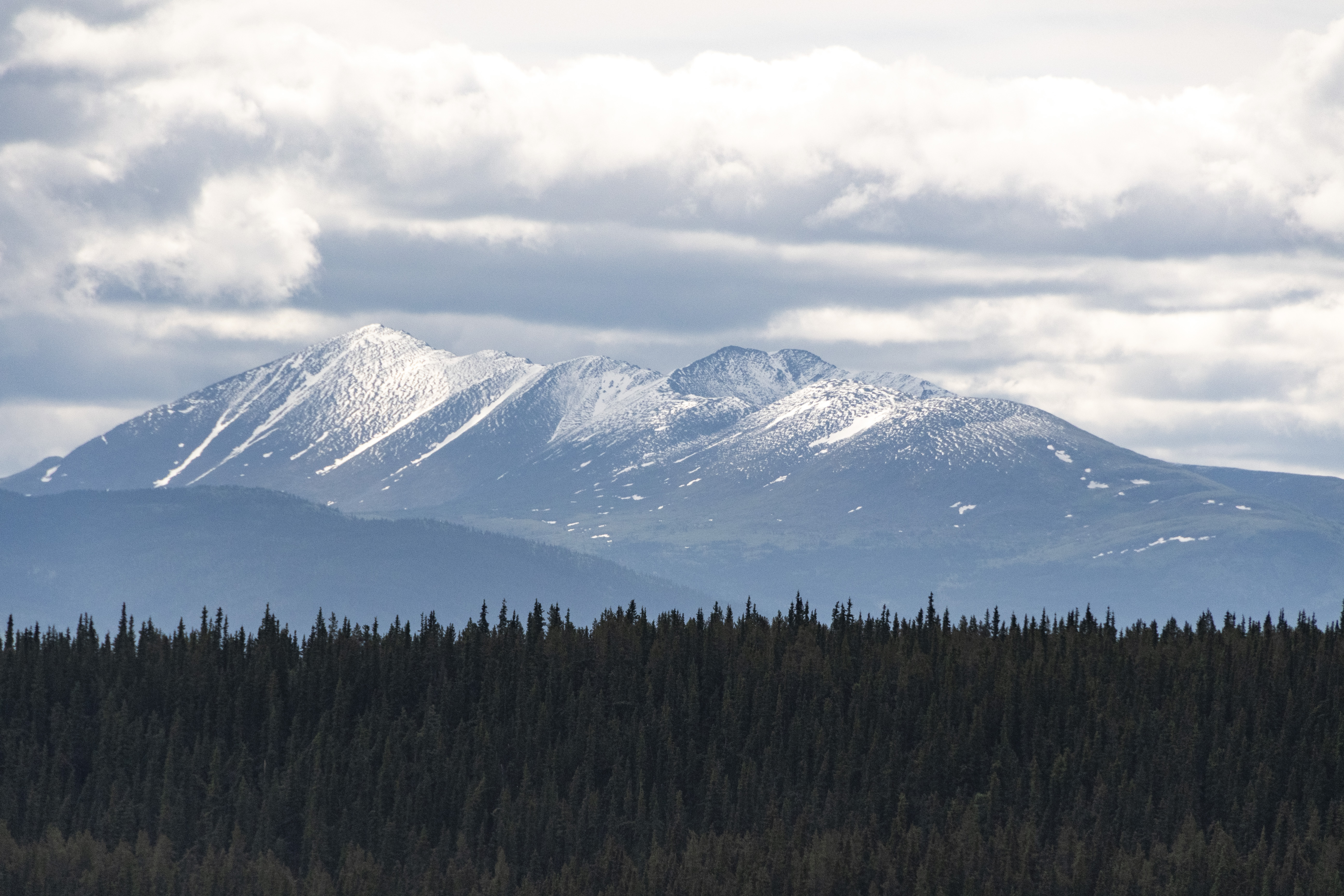
Next morning; which was the 4th of July, we headed to Whitehorse. Along the way we kept getting glimpses of this snow capped mountain. It had snowed in the mountains around Whitehorse the night before.

Not far from arriving in Whitehorse we stopped at this bridge (named the “Big Blue Bridge”) and walked up to an overlook. This is the beginning of The Yukon River. We will see much more of the Yukon River as it winds almost 2,000 miles from here in the Yukon to cross Alaska and empty into the Bering Sea.

Our RV and tow car looking lonely at the Yukon River.


Information and wildflowers from the overlook.

We arrived in Whitehorse and got settled at Pioneer RV Park. This park was unique because they also had gas and diesel tanks so we filled up with their discounted gas at $5.24/gallon (calculated from liters). That afternoon we had a tour of the “Yukon Beringia Interpretative Centre”


Several maps of “Beringia” show the land that was exposed above sea level during the last Ice Age when sea levels were much lower. The Canadian interpreter leading our tour explained that there was no Yukon at that time because most of it was buried under miles of ice. The “land bridge” that is now partially submerged in the Bering Strait allowed passage between the continents.


Another view of Beringia and I don’t know what prehistoric animal that was but it had cool horns.

Sculpture at Beringia.


We had a hands-on demonstration and practice of using a spear throwing stick called an “atlatl”. It was fun but apparently takes a lot more than one time to practice. But the scenery was nice. We aimed at cutouts of prehistoric animals with snow capped mountains behind them.


The Wooly Mammoth and the Giant Beaver became extinct around 10,000 years ago. I had heard of the Wooly Mammoth but was not (until now) familiar with the Giant Beaver. Up to 8′ long and 480 lbs they were about the size of today’s black bears!

The next morning we visited the Whitehorse Visitors Center where we learned about the steam powered paddle-boats that navigated the Yukon and other rivers in the area bringing supplies to the frontier. They had a short 3-4 month season when the lakes and rivers were not frozen. The gold rush, and after that the silver ore mining, made Whitehorse an important hub in the Yukon.


“No grizzly bear hunting” sign along the Alaska Highway. The fine print says “…within 100 meters of either side of the road…” so no shooting from your car windows… but, if you are at least a football field away from the highway, it’s ok. Rules are different here.


Totem pole near the Visitor Center and some info on it.

14 First Nations hold land in the Yukon Territory that cover the entire Territory. Most have modern treaties with self-governance and specific land boundaries called Final Agreements. It is not like in the States where there are much smaller set aside reservations.

Visitors Center photo shows how the paddlewheeler (or sternwheelers) were winched up out of the water for winter and slid back down into the Yukon River in the spring. Each boat would burn a cord of wood each hour. The forests along the river were being cut back each year to supply the steam boilers. From the 1860’s to the 1950’s the paddlewheelers were the primary means of transportation for the Yukon area. The Klondike was the biggest paddlewheeler and was built in Whitehorse in 1829. The original boat hit a rock wall going around a bend then struck a sandbar. It was salvaged and rebuilt as The Klondike II and was initially used to carry freight for the building of the ALCAN road. Very photogenic so here’s a bunch of pics.


The Yukon River at Whitehorse. Becky and I are pinching ourselves when we stand and look out at the Yukon River streaming past. Sort of in disbelief that we are really here. The Yukon River has always been like a fabled river far from where we would ever be. We feel really blessed by God to be able to see this.


Miles Canyon Overlook. The Yukon River shoots through a volcanic basalt rock canyon that was difficult for paddlewheelers to navigate.


Miles Canyon, looking both ways from the suspension bridge.
Miles Canyon video.

Info on Miles Canyon and the Whitehorse Rapids.

21yr old Jack London ran Miles Canyon and Whitehorse Rapids (now gone from a dam built for power generation and flood control).

We did not get a chance to get inside but this log church built in 1900 had an interesting history and is still sitting on it’s original site in what is now downtown Whitehorse.


One last photo from Whitehorse. Our last day in Whitehorse was a laundry day and getting ready to travel again. I tried to replace a windshield wiper today. After an hour I threw it away and went to buy a different one that went on easily. We also bought more black poster board to put in the bedroom windows. Hopefully it will make the room darker and we will sleep better tonight. We leave Whitehorse tomorrow morning for Haines, ALASKA and stay there for 3 nights. Next post will probably be about Haines and a ferry boat trip to Juneau and back to Haines.
Favorite Bible reading verses today: Luke 6:46-49
“Why do you call me, ‘Lord, Lord,’ and do not do what I say? As for everyone who comes to me and hears my words and puts them into practice, I will show you what they are like. They are like a man building a house, who dug down deep and laid the foundation on rock. When a flood came, the torrent struck that house but could not shake it, because it was well built. But the one who hears my words and does not put them into practice is like a man who built a house on the ground without a foundation. The moment the torrent struck that house, it collapsed and its destruction was complete.”

