Stewart, BC & Hyder, AK – August 24-26

Alaskan Adventure: Days 86 & 87. We stayed 2 nights in the town of Stewart, British Columbia. Stewart is a small Canadian town with a population of about 500. We stayed at the “Bear River RV Park.” Stewart and Hyder are both located in beautiful river valleys between very steep mountains.

Until 1972 there were no roads to Stewart. Access was by sea or by air only. Today there is a 37 mile “spur” road called “The Glacier Highway” or “37A” that splits off from the “Stewart-Cassier Highway.” I have a hard time understanding how the “Stewart-Cassier Highway 37” does not actually go to Stewart… but then it doesn’t go to Cassier either. We left Dease Lake early in the morning for the drive to Stewart which was a long 250 miles and 8 hours but with beautiful scenery. The Cassier Highway is not a fast road. It’s a beautiful drive but the road is not as developed as the more popular Alaskan Highway. More sharp curves and mountain grades. It doesn’t have wide cleared edges and has even fewer towns and gas stations.

On the drive: Crossing the Stikine River on the Stewart-Cassier Highway. The Stikine (or Stikeen) River was an alternative route to the 1898 Yukon gold rush. That alternate route started at the mouth of the Stikine River where it enters the Pacific Ocean at Wrangell, Alaska.

What qualifies as a Highway is sometimes pretty minimal. Be sure to notice the itty bitty red “SLOW” sign there right at the edge of the pavement a few feet before the pavement ends…
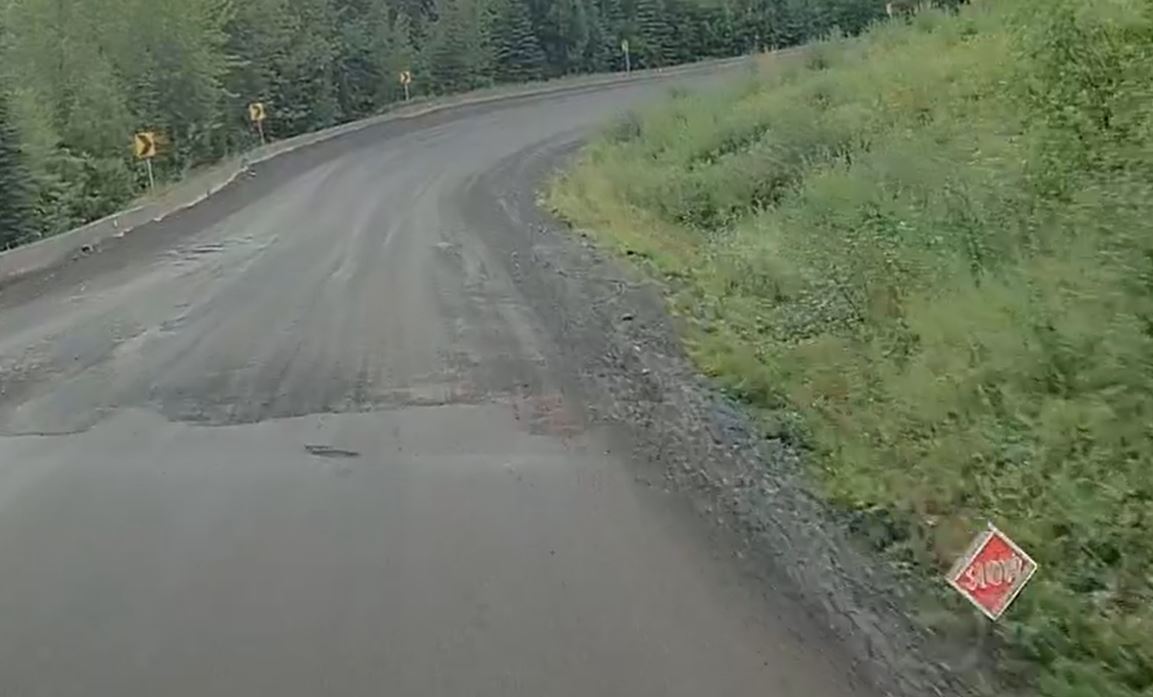
Notifications of changing road conditions, if provided at all, were often obtuse… just a hint to help out.

Day 86_Stewart and HyderIMG_1944
Day 87_Stewart to HazeltonBear Glacier 1
Day 87_Stewart to HazeltonBear Glacier 2

On the 37A road into Stewart we passed the brilliant blue toe of “Bear Glacier”.

Day 86_Stewart and HyderIMG_1938

View of the surrounding mountains from our campground in Stewart.
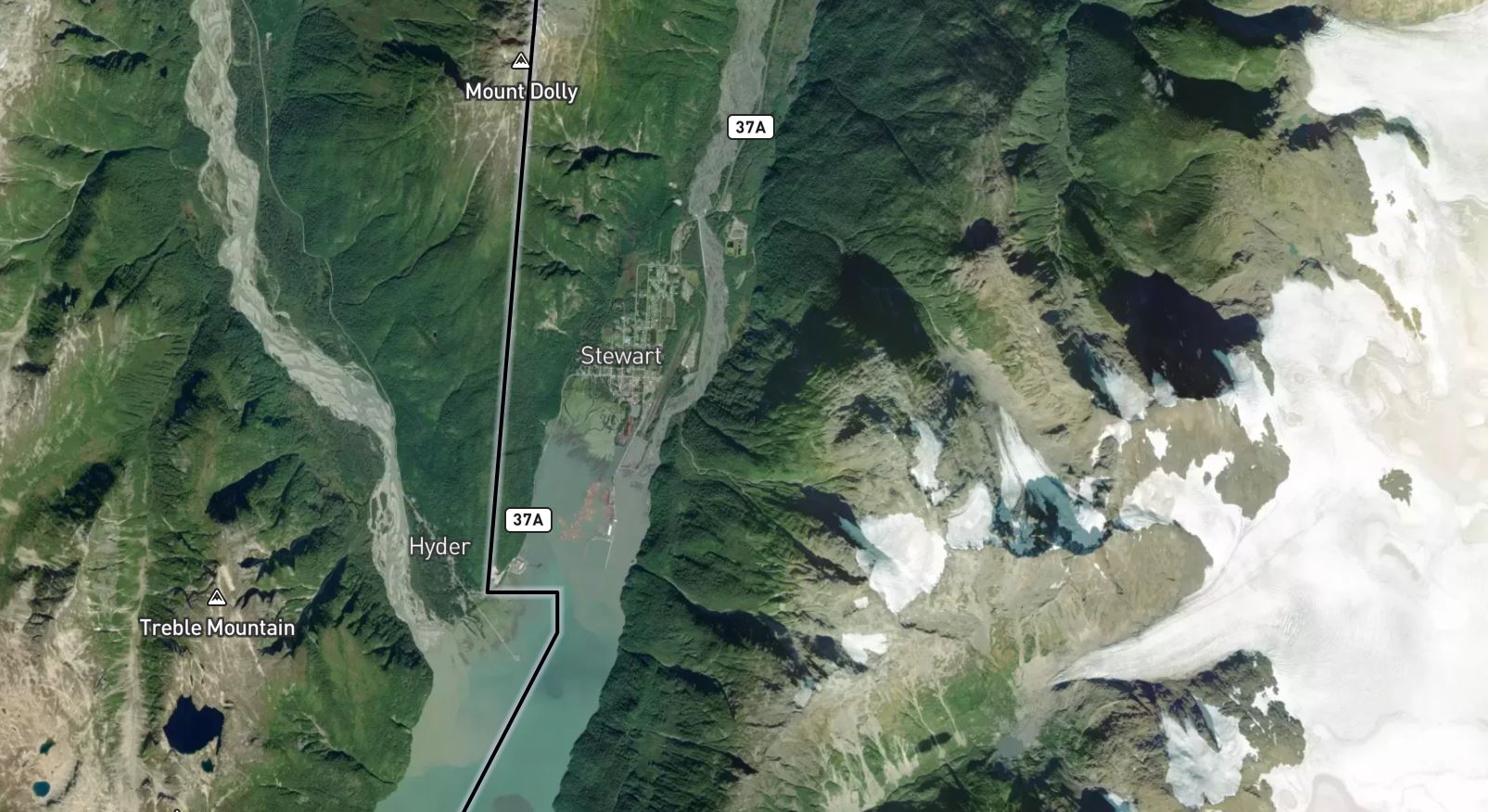
The boundary between Canada and the US runs 70 miles up the Portland Canal (another natural fjord similar to the Lynn Canal) then breaks over at Hyder to follow the mountain peaks. The little Alaskan town of Hyder is located at the south tip of land between the Salmon River (which originates at Salmon Glacier and ends at Hyder, AK), and the Bear River (originating at Bear Glacier and ending at Stewart, BC).

While in Stewart, British Columbia – we visited Hyder, Alaska – which is only 2 miles away. No US passport is required to cross the border from Stewart to Hyder; but you can’t get out of Hyder back into Canada without a passport. We did not go there but there is another Canadian town of Premier, British Columbia that you can only get to by driving through Hyder, Alaska. Premier is notable for being in Canada, but accessible only through a portion of the United States that is accessible only from Canada. Things are just very different in these parts.

We knew we were getting close to the end of our Alaska trip. Hyder, Alaska is a popular destination for people who want to say they’ve “been to Alaska” but don’t want to drive the length of the Alaskan Highway. It’s the closest town you can drive to in Alaska from the lower 48 States (it’s about 1,000 miles from Washington State). Hyder is a very small, very isolated town. 50-60 people live there year-round. There is no US border control because there is only one (dirt) road into Hyder. The road only goes to a glacier (Salmon Glacier), a gold mine, and the Canadian town of Premier before you turn around and come back through Hyder and the Canadian border crossing at Stewart.
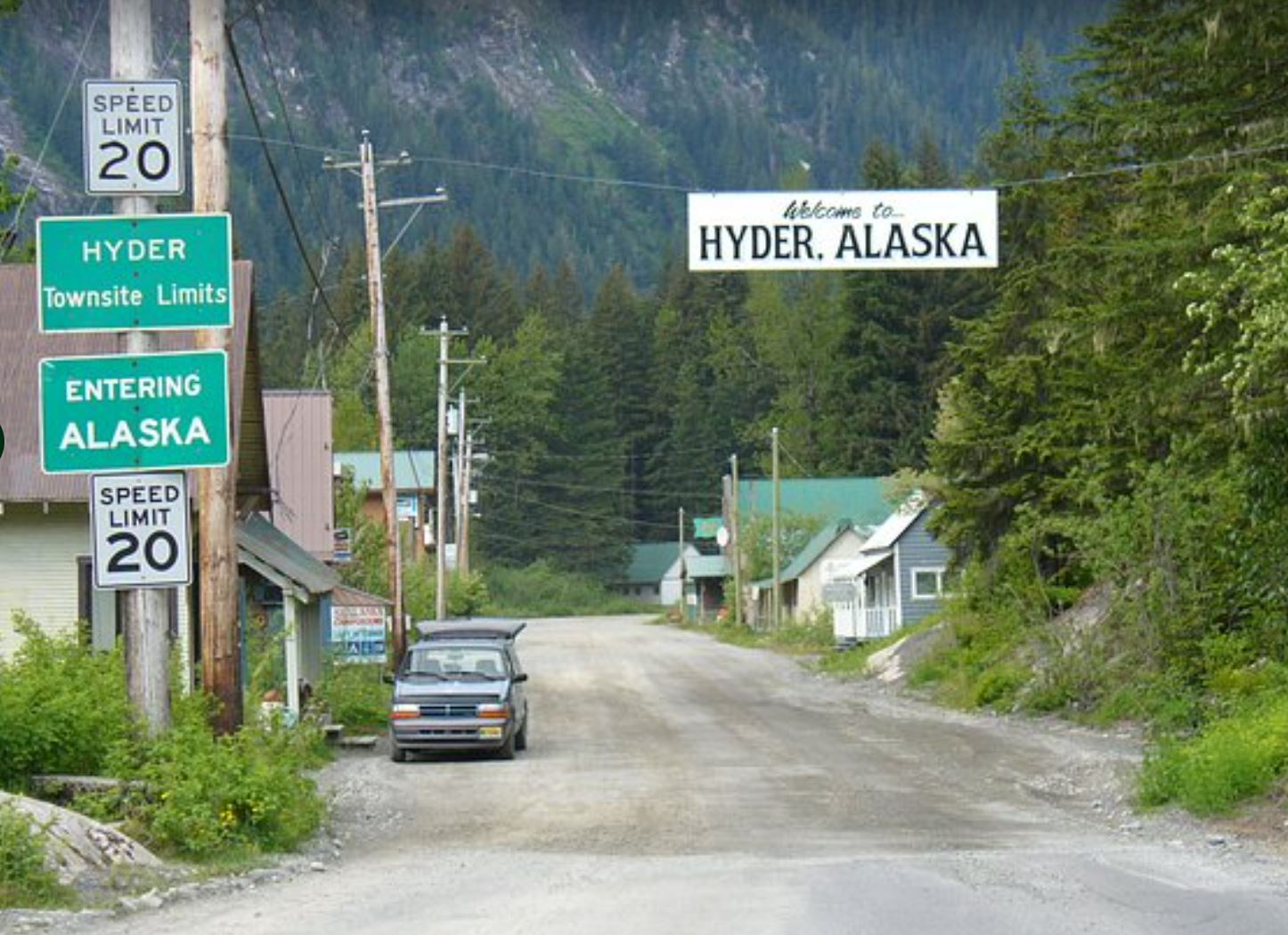
There is only one street into Hyder, it’s dirt; this is it. The pavement ends at the border.
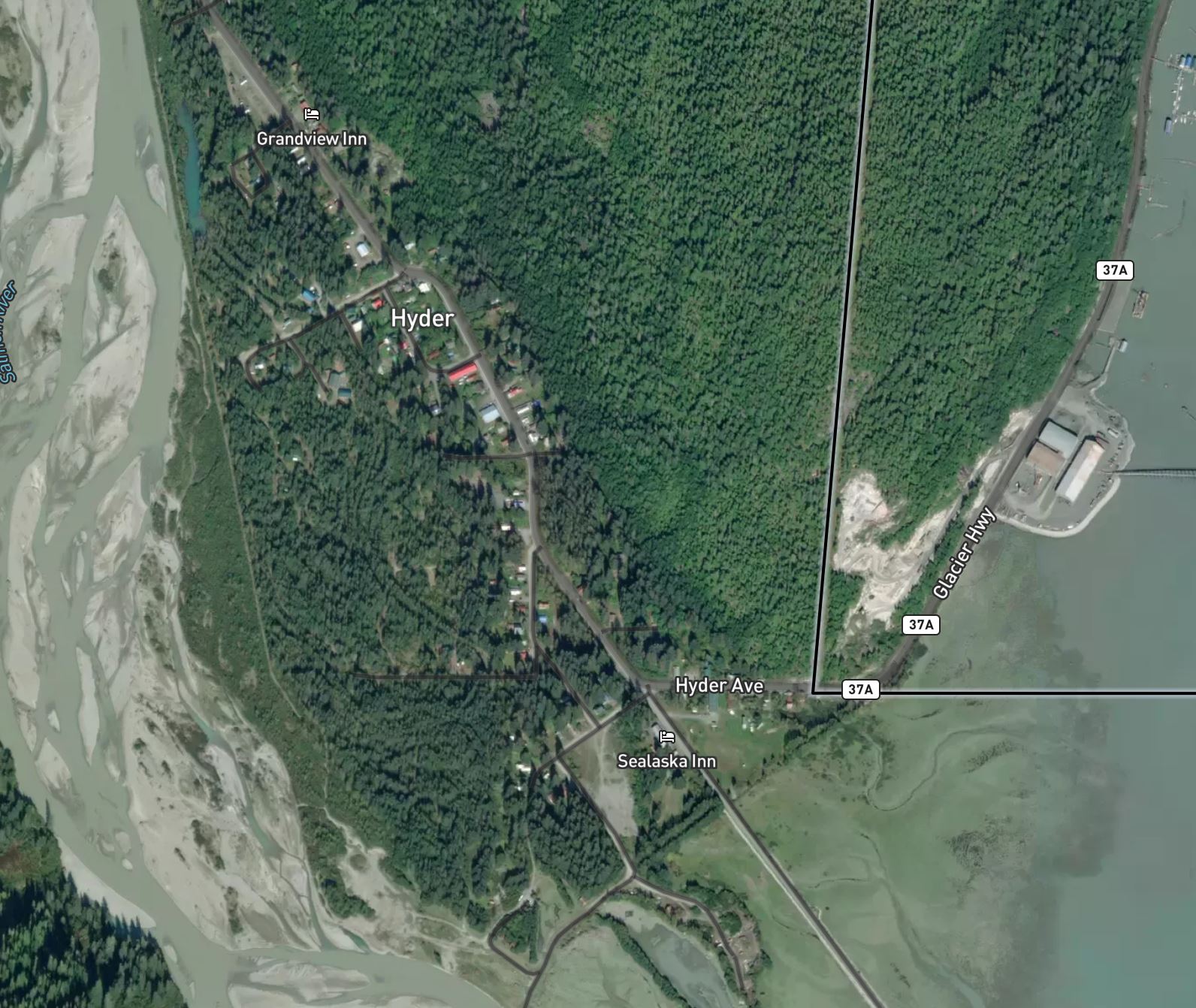
Google Maps shot of the Town of Hyder.

Day 86_Stewart and HyderIMG_1923

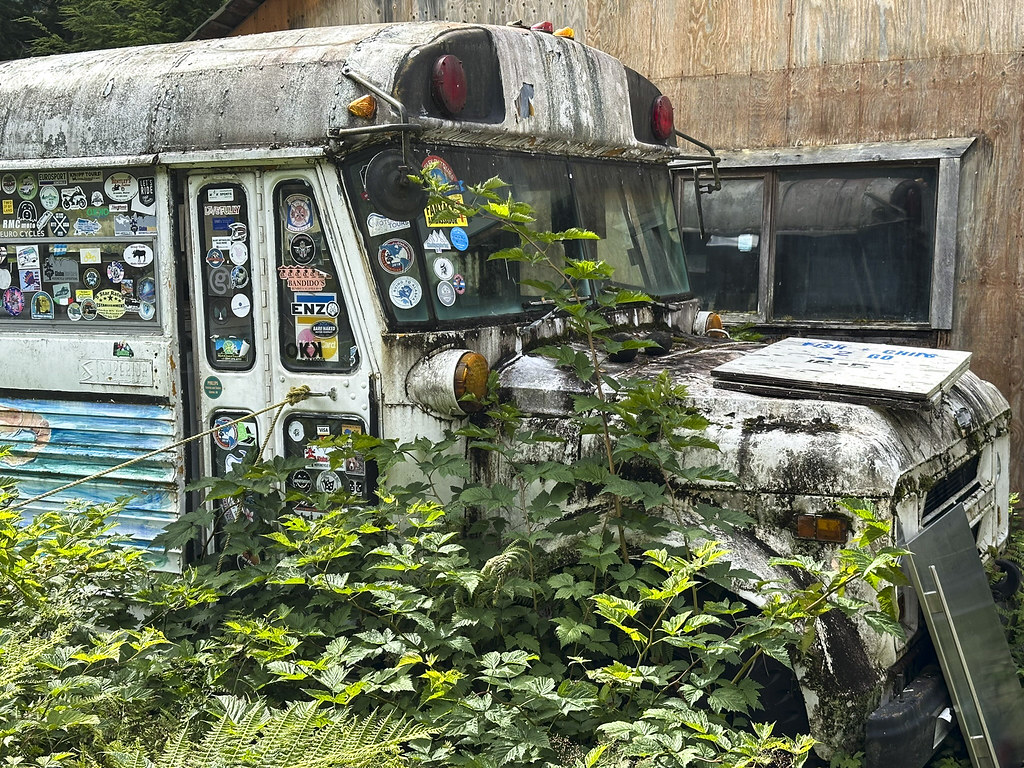
Our first goal was to find “The Bus” where we hoped to get lunch. The Bus was recommended as the best fresh halibut fish-n-chips in Alaska so we were eager to try it out.
Day 86_Stewart and HyderIMG_1936

We were a little disappointed to find The Bus down a pothole filled dirt road. There was a sign saying open at 12:00 and we were early but doubted it would ever open…

Day 86_Stewart and HyderIMG_1924

Roadside Hyder, Barbie Van…

Day 86_Stewart and Hyder_DAD4667

This was the first bear we saw the morning we drove into Hyder. Just ambling along crossing the road near the Post Office and walking away licking his chops.

Day 86_Stewart and Hyder_DAD4672

We visited the “Fish Creek Wildlife Observation Site” where an elevated wooden boardwalk runs along a shallow creek. Chum Salmon and Pink Salmon come here to spawn. The salmon attract bears and bald eagles. We did not see any bears here in the morning but did when we came back again in the evening.

Day 86_Stewart and Hyder_DAD4698
Day 86_Stewart and Hyder_DAD4701

Fireweed. An edible plant and we were told it makes the best honey.

Day 86_Stewart and HyderUntitled_Panorama-1

Fish Creek at the Wildlife Observation Site.

Day 86_Stewart and Hyder_DAD4784

Lots of Bald Eagles fishing in the river.

Day 86_Stewart and Hyder_DAD4795

And hanging out in the trees along the river.

Day 86_Stewart and HyderUntitled_Panorama-1

A beautiful river valley surrounded by snow capped mountains. It was getting to be late summer so most of the snow has melted.

Day 86_Stewart and HyderIMG_1933

Another view of the river and mountains near Hyder.

Day 86_Stewart and Hyder_DAD4808

Far away shot of a bear with a big salmon.

Day 86_Stewart and Hyder_DAD4773

There was a place to pull off along the road and walk through some brush to the river. I did that while Becky waited in the car. There were too many trees to get a good picture so I was about to walk back when there was a splash below. This grizzly bear had been right below me. Oblivious me had no idea he was there. Fortunately he was hunting for salmon instead of a stupid tourist.

Day 86_Stewart and Hyder_DAD4762

My, what big paws (and claws) you have…

Day 86_Stewart and Hyder_DAD4772

My heart was beating pretty fast but I stayed to get some more pictures of a wild bear. An exciting experience. That evening I watched another bear climb up a steep bank after swimming a deep river and realized he could have gotten to me much faster than I could have gotten back to the car.

After that excitement we returned (through Canada checkpoint) to Stewart to see the town and the Visitors Center. We met up with Mike and Amy and returned to The Bus for lunch.

Day 86_Stewart and HyderThe Bus

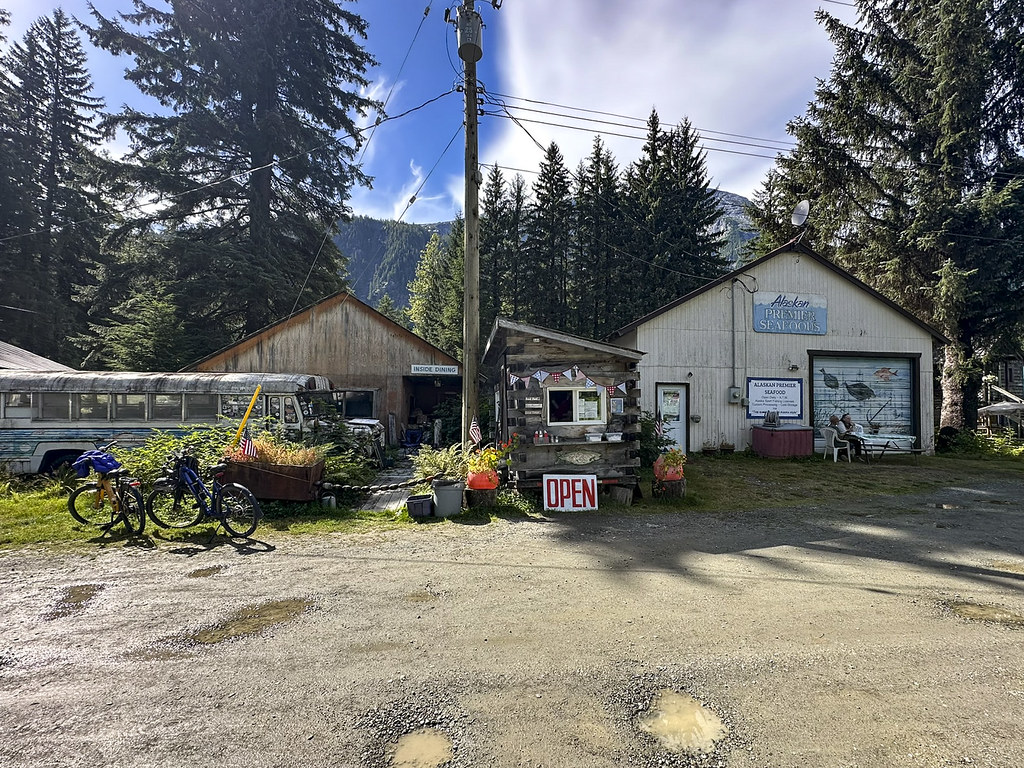
The Bus is abandoned now but the adjacent shed still serves up lunch to hungry visitors. One lady runs the whole thing so it is a slow process but sweetly personal. Her husband does the fishing every day and she does the cooking. He chatted with people about life in Hyder while we waited. He noted that last winter Hyder received 22 FEET of snow and several buildings collapsed. Then the spring melt and glacier outwash flooded away lots of stuff including most of the wooden boardwalk at the Fish Creek Wildlife Observation Site. That is a big problem because it reduced tourism to Hyder which they are so dependent on.

Day 86_Stewart and HyderThe Bus Before

This is a clip from the internet of The Bus a few years ago. Hard times in a harsh place.
Day 86_Stewart and HyderIMG_1937

A last look at The Bus after nearly everyone had left. Sort of like a Sonic Drive-In but way more remote.

Day 86_Stewart and HyderSalmon Glacier Hyder

Another clip from the internet. We did not drive up to Salmon Glacier. Looks like it would have been awesome.

In the evening, our group had a friendly pitch-in dinner of biscuits-n-gravy at the campground in Stewart. We made some crock-pot cinnamon monkey-bread dessert.

Day 86_Stewart and Hyder_DAD4821

After dinner, we went back into Hyder and back to the Fish Creek Wildlife Observation Site in the evening. We were about to give up and leave when Amy whispered “there’s one right over there”. It was a misty/foggy evening and I am sure I would not have spotted this stealthy bear sneaking up in the grass.

Day 86_Stewart and Hyder_DAD4836

Mr. Bear decided there were too many people watching from the boardwalk so decided to swim across the creek.

Day 86_Stewart and Hyder_DAD4857
Day 86_Stewart and Hyder_DAD4851

The bear was a surprisingly good swimmer, it was even more impressive to see him heave himself straight up the river bank on the other side.

FullSizeRender-1

Hyder is known for having lots of bears hanging around, especially when the salmon are running up the river.

Salmon fishing, laid-back bear style. iPhone video by Joe & Lori.

A fat bear. iPhone video by Joe & Lori.

Day 5_Bear Glacier_StewartUntitled_Panorama-3

Leaving Stewart on a chilly foggy morning took us past the toe of Bear Glacier again. The “spur” road 37A into and out of Stewart was one of our “top 10” most beautiful drives of the trip

Favorite Bible verse of the day: Psalm 72:17-20

May his name endure forever;
May his name increase as long as the sun shines;
And let men bless themselves by him;
Let all nations call him blessed.

Blessed be the Lord God, the God of Israel,
Who alone works wonders.
And blessed be His glorious name forever;
And may the whole earth be filled with His glory.
Amen, and Amen.

The prayers of David the son of Jesse are ended.

Whitehorse, Watson Lake, & Dease Lake – August 20-24

Alaskan Adventure: Days 81 – 85. Three nights at Whitehorse and one night each at Watson Lake and Dease Lake. The first day in Whitehorse was the bus and train ride to Skagway and back (covered in the previous post). The second day in Whitehorse Becky went to get her nails done and to a laundromat while I rode with Mike and Amy to visit the fish ladder and the “Yukon Wildlife Preserve.” The afternoon was spent doing grocery shopping, pressure washing the RV and tow car, and changing the oil in the RV. Leaving Whitehorse on the 23rd, we drove east and retraced our drive back to Watson Lake via the Alaskan Highway (Watson Lake is where we had visited the Signpost Forest previously). Then the next day we drove south to the town of Dease Lake via a different road called the Stewart-Cassiar Highway. Lots of driving but the roads gradually improve a bit going south where there are more people, better maintenance, and less permafrost. The scenery along the highway was beautiful.

Day 81_Whitehorse to Skagway White Pass TrainIMG_1908

We were back to Whitehorse where we had stayed on the early part of our trip up into Alaska. The city gets it’s name from the White Horse Rapids on the Yukon River.

IMG_1882

$249 dollars (Canadian dollars) for a gas fill-up for the 55 gallon tank on the RV was not uncommon.

Day 81_Whitehorse to Skagway White Pass Train_DAD4373

The starry night sky from our campsite at Whitehorse.

Day 82_Whitehorse Fish Ladder_DAD4491

Salmon runs are incredibly important to most northern communities.

The White Horse rapids (that the gold rush miners had to navigate in their hand-made boats) have been replaced with a hydroelectric dam. The dam provides power and the “World’s Longest Wooden Fish Ladder” provides a way for returning salmon to continue upstream around the dam.

Day 82_Whitehorse Fish Ladder_DAD4493

Mike pondering a portion of the fish ladder from the viewing platform.

Day 81_Whitehorse to Skagway White Pass TrainIMG_1903

Path of the Yukon River from Bering Sea to Dawson City and Whitehorse, Yukon.

Day 81_Whitehorse to Skagway White Pass TrainIMG_1904

2,000 miles, without eating, all swimming upstream. I cannot wrap my brain around that…
Imagine if a salmon moves upstream one foot upstream for every tail flip-it, would take over 10 Million tail flips to go 2,000 miles…
It would take a person walking 20 miles a day, without any breaks (into a raging headwind and without eating) over 3 months to walk that far… how fish can do that is beyond me.

Day 82_Whitehorse Fish Ladder_DAD4492

Another map showing the Yukon River 2,000 mile salmon spawning route from the Bering Sea to Whitehorse.
For a sense of that; the drive from Indianapolis to Los Angeles, California is about 2,000 miles.

After the visiting the fish ladder and a breakfast of crepes at the hard to find “Crêperie La Petite Maison” in Whitehorse, we went on a guided tour at the cleverly named “Yukon Wildlife Preserve”. The next group of photos is from the Preserve visit.

Day 82_Whitehorse Fish Ladder_DAD4509
Day 82_Whitehorse Fish Ladder_DAD4499
Day 82_Whitehorse Fish Ladder_DAD4512
Day 82_Whitehorse Fish Ladder_DAD4534
Day 82_Whitehorse Fish Ladder_DAD4549
Day 82_Whitehorse Fish Ladder_DAD4555
Day 82_Whitehorse Fish Ladder_DAD4624
Day 82_Whitehorse Fish Ladder_DAD4597

The Lynx was cool but hard to photograph through fencing.

Day 82_Whitehorse Fish Ladder_DAD4563
Day 82_Whitehorse Fish Ladder_DAD4589

That’s it for Whitehorse. The next morning we headed southeast on the Alaskan Highway to cross from Yukon back into British Columbia and the town of Watson Lake.

Passing through Teslin, Yukon and crossing the Nisutlin Bay Bridge. We had camped here at the Yukon Motel & Restaurant on the way up the Alaskan Highway.

Just a video of driving the Alaskan Highway.

We needed to get gas in Watson Lake before heading south the next morning on the Stewart-Cassier Highway. Here’s a video of driving through Watson Lake past the Signpost Forest for a sense of how crazy many signposts are there. There is not much to this town but they work hard to make it a tourist destination.

Day 83_Watson and Dease LakeIMG_1910
Day 83_Watson and Dease LakeIMG_1913

Picture of a roadside map where we stopped at “Rabid Grizzly”. Highway 37 is what we were traveling south on when we left Watson Lake. The highway is usually called the “Stewart-Cassiar Highway”. The gray portion of the map at the top is Yukon Territory, the tan colored is British Colombia, and the White is Alaska. Skagway, Carcross, and Whitehorse are at the top left.

Day 83_Watson and Dease LakeIMG_1918

Screenshot from my phone showing generally where we were now and a bunch of other gray dots showing places we had been and were planning to go. The lowest gray dot below where we were currently located at Dease Lake is Prince George. Prince George is where the group trip would end. We still had quite a way to go.

Day 83_Watson and Dease LakeIMG_1911

Colorful rock cut along the way. There was a pull-off area where we took a break here.

Day 83_Watson and Dease LakeIMG_1912
Day 83_Watson and Dease LakeIMG_1916

Dease Lake from the campground dock. Back in 1837, Robert Campbell established a Hudson’s Bay Trading Post on this lake. At that time is was not welcome because it created fur trading competition with the local native communities.

Day 83_Watson and Dease LakeIMG_1917

Stacked rocks on the shore of Dease Lake.

Day 83_Watson and Dease LakeIMG_1914

The hand drawn map of Dease Lake Waters Edge Campground is “rustic” like the campsites. This campground provided a spot to pull in and stay the night but that’s it. No electric, no water, no sewer, no showers. This is “off grid” camping (there was a pit toilet). To be fair, this is the only campground, at the biggest town around. We ran the generator in the morning to make coffee but we did fine with battery power for everything else that night.

Day 83_Watson and Dease LakeIMG_1920

There is one gas station in the town of Dease Lake (population 200’ish). The gas pumps are covered in stickers from Stewart-Cassiar Highway travelers. Apparently this is a really popular “thing” slapping stickers on stuff everywhere. Many of the stickers are custom made for people’s ‘trip of a lifetime’. Big Foot seemed to be a popular theme.

Day 83_Watson and Dease LakeIMG_1919

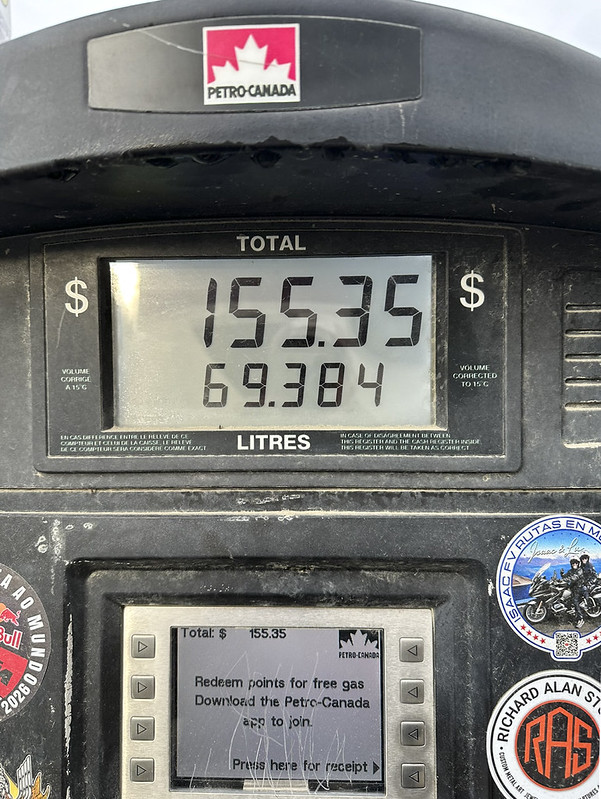
Leaving Dease Lake in the morning we filled up with possibly the most expensive gas on the trip. That translates right at $9.00 a gallon in Canadian dollars, or $6.42 in US dollars.

Next stop is the towns of Stewart, British Colombia and Hyder, Alaska.

Favorite Bible verse for today: Psalm 16:11

“You will make known to me the path of life; In Your presence is fullness of joy; In Your right hand there are pleasures forever.”

Skagway, Alaska: White Pass & Yukon Railroad – August 20

Alaskan Adventure: Day 81. A ride on the scenic and historic White Pass & Yukon Railroad.

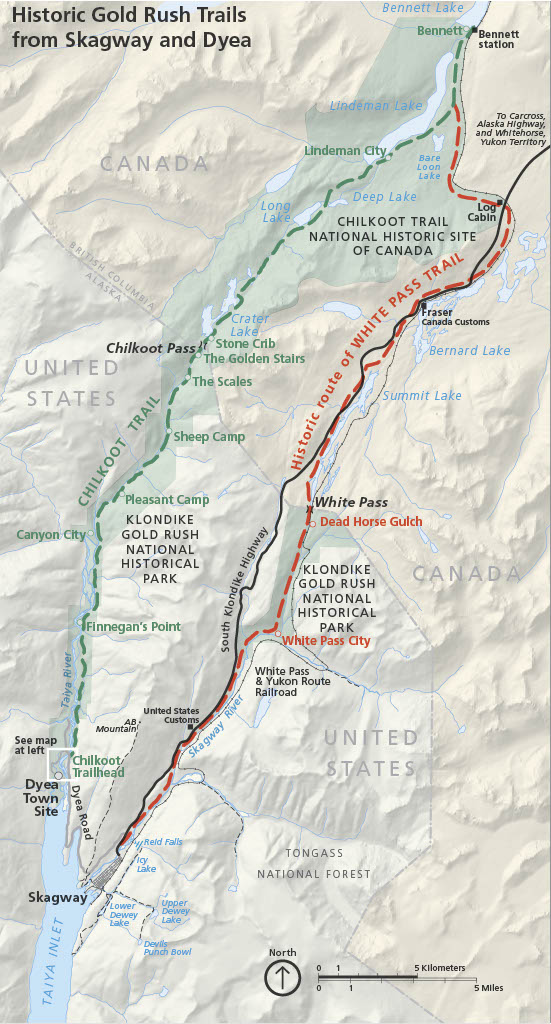
This post is about the Yukon Gold Rush, one of the biggest gold stampedes. It needs a map and a some context:

July 1897. America was in a depression with high unemployment when ships arrived in Seattle and San Francisco loaded with rich men and lots of GOLD from the Yukon. The Yukon Gold Rush was on! (the discovery of gold actually happened almost a year previously but few knew about it). If you were wealthy enough you could take a ship and sail from Seattle or San Francisco all the way up to where the Yukon River empties into the Bering Sea and then upstream on the Yukon to Dawson City, a trip of at least 4,000 miles but relatively easy for the traveler. There were quicker, less expensive, but far more difficult routes to the Yukon gold fields. Eleven days after news of gold arrived in San Francisco, Jack London convinced his sister to mortgage her home for Jack to buy 2,000 pounds of supplies and book passage on a steamship to Juneau, Alaska. From Juneau he hired local indigenous canoers to paddle him and his gear 100 miles up the Lynn Canal to Dyea, Alaska. The town of Dyea is now gone with little evidence remaining (because it was mostly a “tent town”). Dyea has a shallow harbor on the outwash delta of the Taiya River. The nearby town of Skagway was the other choice and is on a deep water harbor. Today cruise ships anchor at Skagway. The map below shows the two competing routes from the north end of the Lynn Canal to Bennett Lake. Jack London and everyone headed to Dawson City included woodworking tools because Bennett Lake is the beginning of the Yukon River. Once they got over the Chilkoot or White Pass they had to build a boat on the south shore of the lake and head downstream. It is about 500 miles to Dawson City by the Yukon River.

Map of Chilkoot and White Pass Trail Routes and White Pass & Yukon Route Railroad.

The two routes compared:
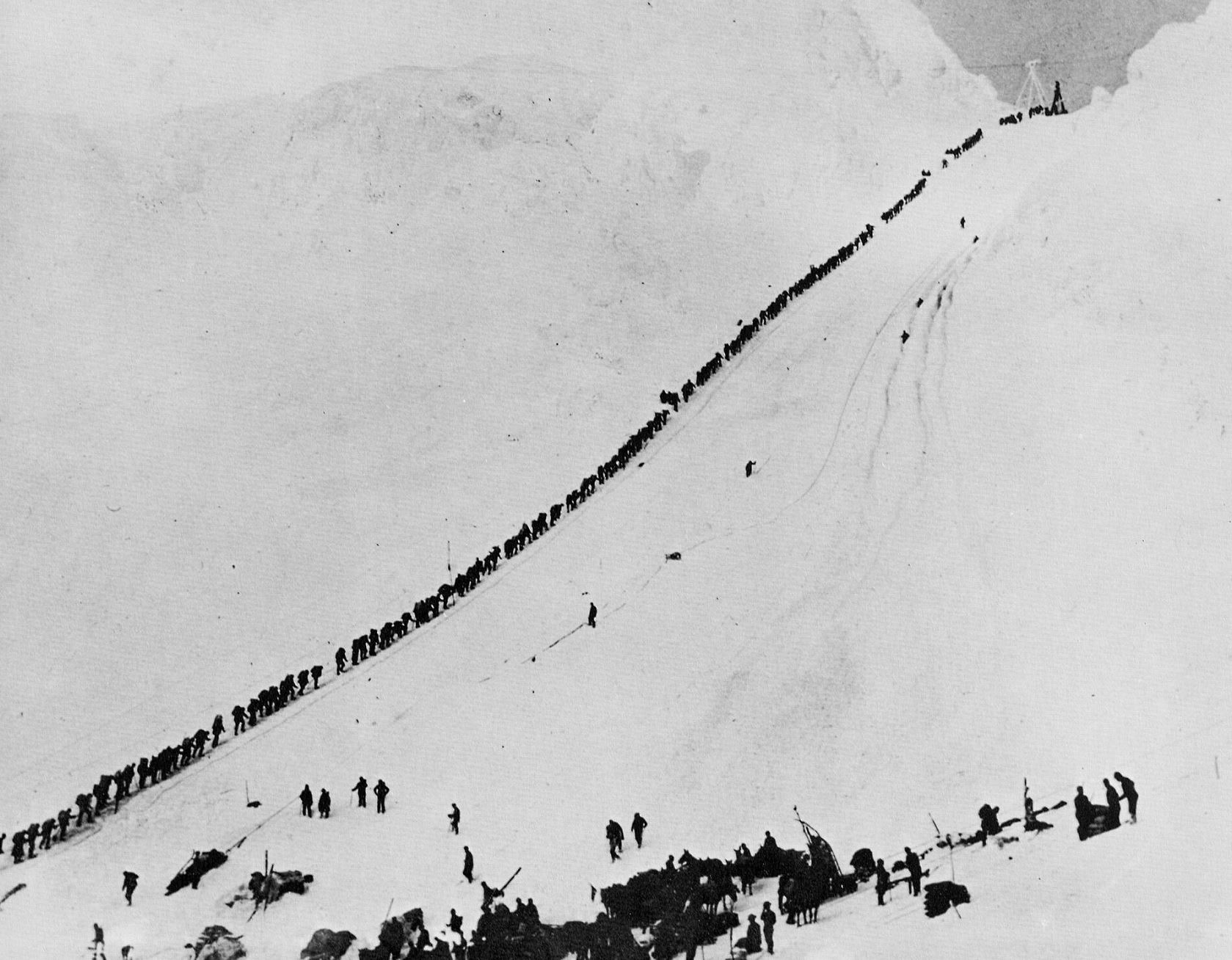
1. The Chilkoot Trail started at Dyea and was the shorter route. This route is famous for the pictures of stampeders climbing the “Golden Stairs” to Chilkoot Pass at the Canadian border. This route was entirely by foot as pack animals could not navigate the steep, icy terrain.

Chilkoot Trail: climbing the “Golden Stairs” to the summit of Chilkoot Pass and the Canadian border.


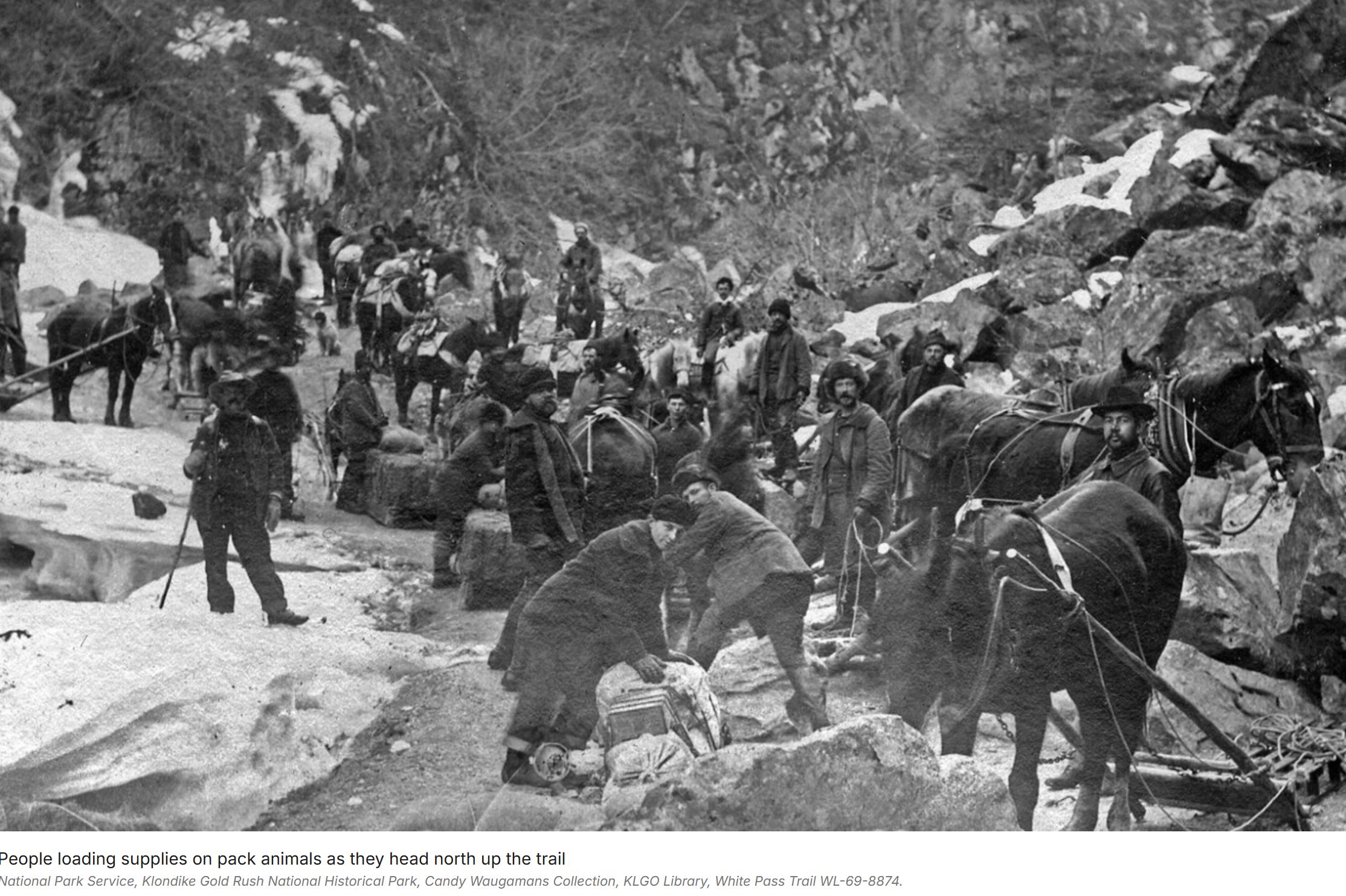
2. The White Pass Trail started at Skagway and while a longer route could be navigated by pack animals, mostly horses. An estimated 3,000 horses died in a single year along the route with carcasses and bones a frequent site.

“The horses died like mosquitoes in the first frost and from Skagway to Bennett they rotted in heaps. They died at the rocks, they were poisoned at the summit, and they were starved at the lakes; they fell off the trail, what there was of it, and they went through it; in the river they drowned under their loads or were smashed to peices against the boulders; they snapped their legs in the crevices and broke their backs falling backwards with their packs; in the sloughs they sank from fright or smothered in the slime; and they were disemboweled in the bogs where the corduroy logs turned end up in the mud; men shot them, worked them to death and when they were gone, went back to the beach and bought more. Some did not bother to shoot them, stripping the saddles off and the shoes and leaving them where they fell. Their hearts turned to stone- those which did not break- and they became the beasts, the men on the Dead Horse Trail.” -Jack London, Journalist.

White Pass Trail: (aka: Dead Horse Trail)

Of course enterprising people quickly figured out that an easier way to the gold fields would be a train. Train tracks were quickly blasted along the edge of the canyon following the White Pass Trail. The narrow gauge train track (3′ wide) was finished only 3 years later from Skagway to Whitehorse by July of 1900. The train eliminated the deaths of horses on the trail but missed most of the Yukon gold rush because the gold rush was over by the time it was completed.

The train continued to be an important part of access to the Yukon interior for travelers but was mostly used for hauling silver, copper, and lead ore out of the interior to the Skagway port. The huge gold dredges and other mining equipment came up the White Pass & Yukon Railroad. During WWII the railroad brought much of the equipment and supplies to White Horse for the construction of the Alaskan Highway. After being abandoned around 1982, the railroad was rehabilitated in 1988 and reopened as a heritage and scenic railway. Now the railway only runs from Skagway to Carcross (not all the way to White Horse). It was this railway that we traveled on our trip.

Day 81_Whitehorse to Skagway White Pass Train_DAD4397

We boarded a tour bus at our White Horse, Yukon campground in the morning and stopped for a coffee and pastry break in the small town of Carcross (also Yukon). The bus then stopped in the town of Fraser (British Columbia) where we boarded the White Pass & Yukon Route Scenic Railway. The bus trip was 88 miles. The train ride from Fraser to Skagway was 28 miles. Picture above is the train rounding a curve somewhere near the summit of the White Pass.

Day 81_Whitehorse to Skagway White Pass Train_DAD4393

Remnants of the Gateway depot stop. The train engines are now diesel powered but some of the water tanks serving the original steam engines remain.

Day 81_Whitehorse to Skagway White Pass Train_DAD4401

It was an overcast day with a few rain showers. Some areas were thick with fog.

Day 81_Whitehorse to Skagway White Pass Train_DAD4427

This old trestle bridge is abandoned.

Day 81_Whitehorse to Skagway White Pass Train_DAD4422

The steel bridge that replaced the old trestle.

Day 81_Whitehorse to Skagway White Pass Train_DAD4436

Entering one of the tunnels.

Day 81_Whitehorse to Skagway White Pass TrainUntitled_Panorama-3

This is the view looking down into the canyon (Dead Horse Gulch) from the railroad above. That trail through the rocks is the “Trail of ’98” also know as the “Dead Horse Trail”. The Dead Horse name came from the thousands of pack horse and mule carcasses that littered the trail as gold rush miners attempted to bring one ton (2,000 pounds) of food and supplies from the port at Skagway, up the rocky, narrow trail to the White Pass and on to the headwaters of the Yukon River. The one ton was based on 3 pounds of food a day for one year plus clothing, firearms, tools, and other survival gear. A man could only carry a 50-80 pound backpack up the icy trail. Assuming an 80 pound pack, it would take 25 round trips back and forth to move one ton of supplies. On the shorter 33 mile Chilkoot Trail that would amount to 1,650 miles of hiking (half of it with an 80 pound pack) just to get to Bennett Lake and start down the Yukon River.

Day 81_Whitehorse to Skagway White Pass Train_DAD4402

Another glimpse of the ’98 trail. You can still hike the trail but only as far as the border to Canada.

Day 81_Whitehorse to Skagway White Pass Train_DAD4417

Trail marker.

Day 81_Whitehorse to Skagway White Pass TrainIMG_1898
Day 81_Whitehorse to Skagway White Pass Train_DAD4440

Misty Canyon.

Day 81_Whitehorse to Skagway White Pass Train_DAD4441

Crossing a wooden trestle.

Day 81_Whitehorse to Skagway White Pass Train_DAD4446
Day 81_Whitehorse to Skagway White Pass Train_DAD4479
Day 81_Whitehorse to Skagway White Pass Train_DAD4487
Day 81_Whitehorse to Skagway White Pass TrainIMG_1889

“Downtown” Skagway. The railway used to run right down the middle of this road.

Day 81_Whitehorse to Skagway White Pass TrainIMG_1890
Day 81_Whitehorse to Skagway White Pass TrainIMG_1891

We ate lunch here with Mike and Amy.

Day 81_Whitehorse to Skagway White Pass TrainIMG_1893

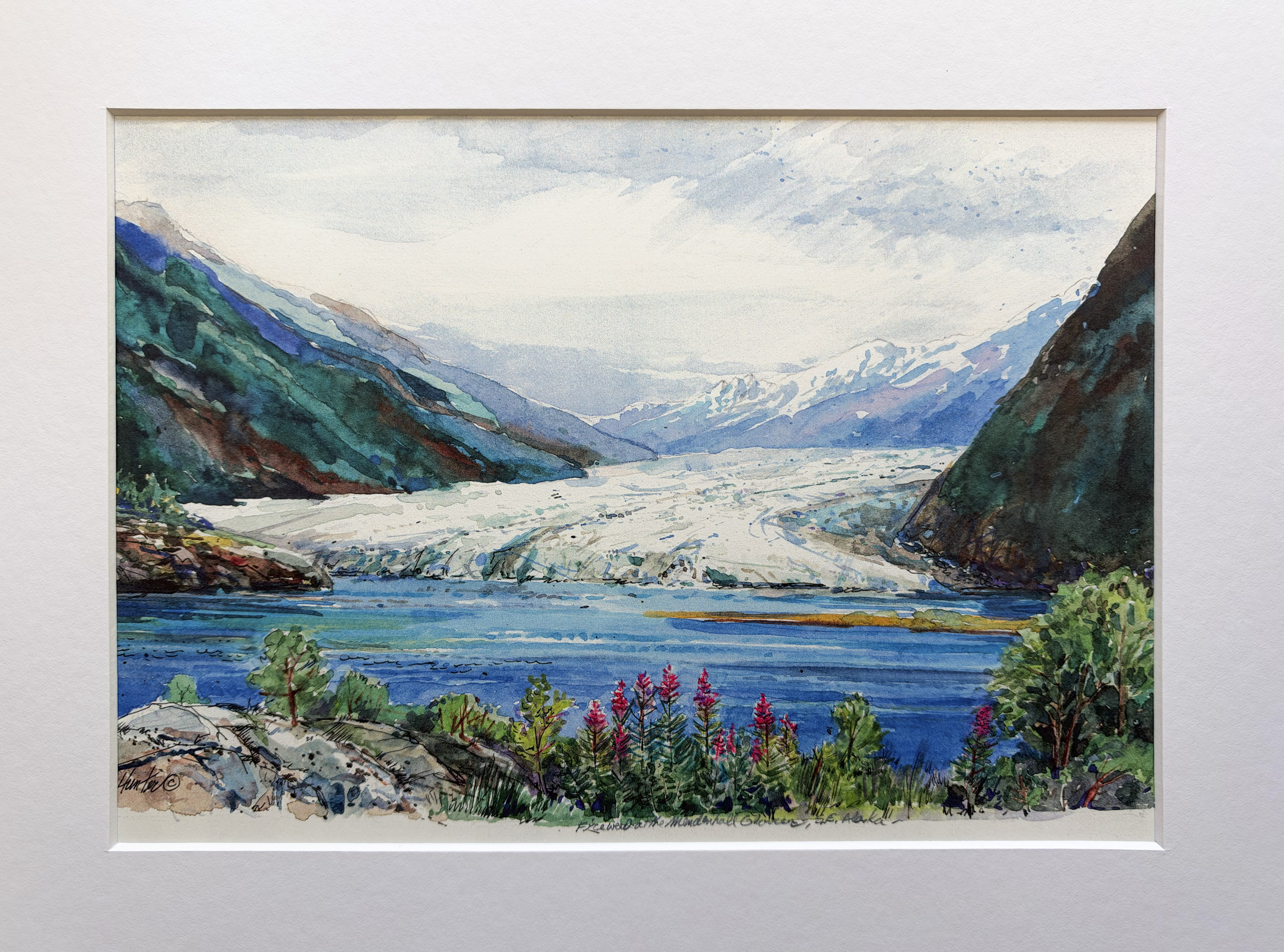
We bought a watercolor print in this shop.

The print with mountains, Mendenhall Glacier and Fire Weed.

Day 81_Whitehorse to Skagway White Pass TrainIMG_1896
Day 81_Whitehorse to Skagway White Pass TrainIMG_1899
Day 81_Whitehorse to Skagway White Pass TrainIMG_1895
Day 81_Whitehorse to Skagway White Pass TrainIMG_1894
Day 81_Whitehorse to Skagway White Pass TrainIMG_1900

Quite an assortment of tough guys in search of gold.

Day 81_Whitehorse to Skagway White Pass TrainIMG_1901

Sketch I liked in the visitors center.

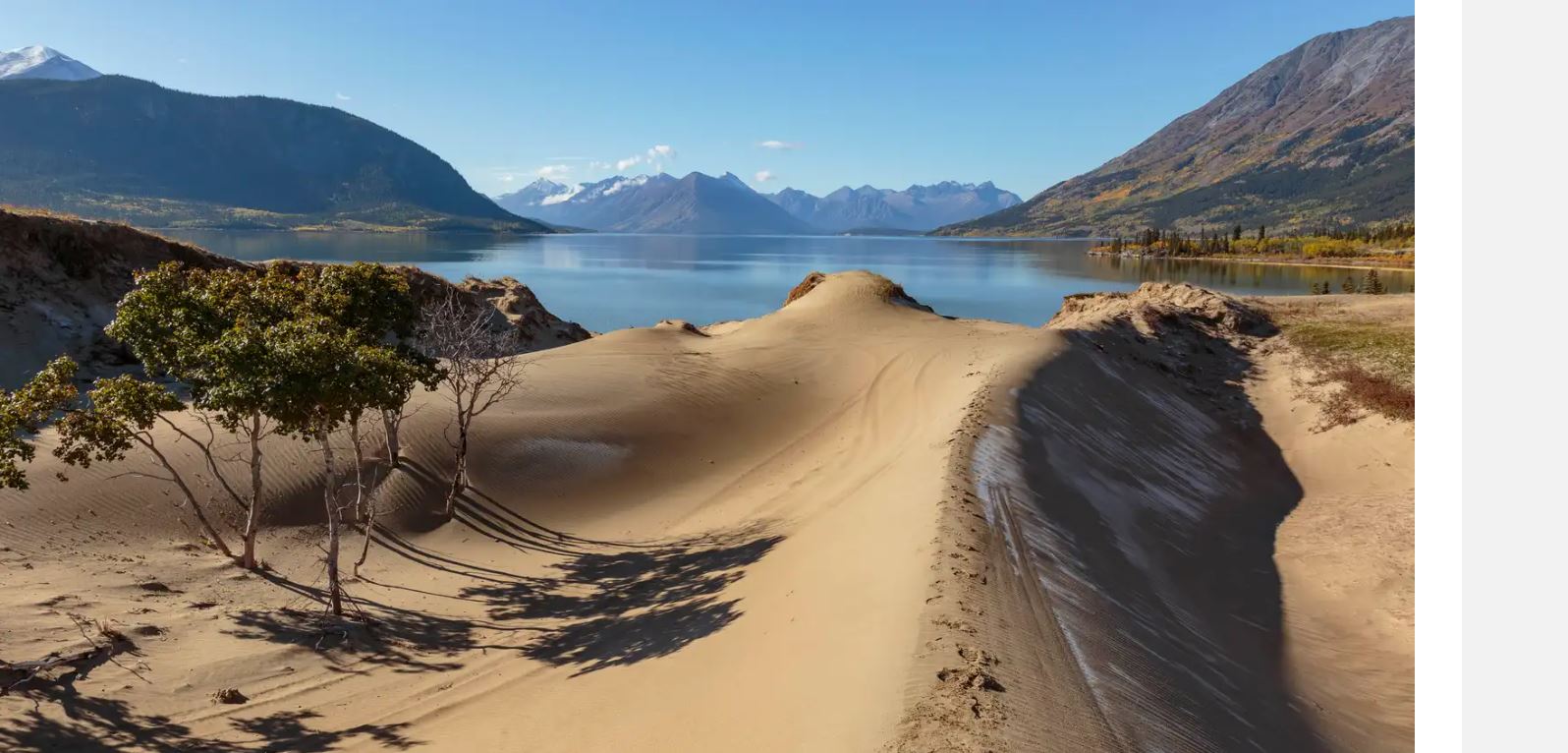
Picture from the Internet of the “Carcross Desert”. One square mile of sand dunes at the north end of Bennett Lake.
Day 81_Whitehorse to Skagway White Pass TrainUntitled_Panorama-2

The trip from Skagway back to Whitehorse was all by tour bus. The weather cleared up and we had some beautiful scenery. This is Emerald Lake.

Favorite Bible verse of the day: Revelation 4:11

“Worthy are You, our Lord and our God, to receive glory and honor and power; for You created all things, and because of Your will they existed, and were created.”

Dawson City to Whitehorse, Yukon – August 18 & 19

Alaskan Adventure: Days 79 & 80. The Klondike Highway out of Dawson; 219 miles to the town of Carmacks was mostly paved but very rugged. Because we were still so far north the roads are less maintained and built on frozen ground. Sort of melancholy feeling that we were now headed back south toward the end of the trip. After a one night stay in Carmacks we continued south arrive back in Whitehorse where we had stayed on our way “up” to Alaska. I only have photos of the day from Dawson City to Carmacks. The main things I remember about the leg from Carmacks to Whitehorse were that the roads continued to improve a bit as we went further south, and driving past Lake Laberge. Lake Laberge figures heavily in “The Cremation of Sam McGee” by Robert Service. Here’s a link to that poem: https://www.poetryfoundation.org/poems/45081/the-cremation-of-sam-mcgee

Day 79_Dawson City to CarmacksCapture

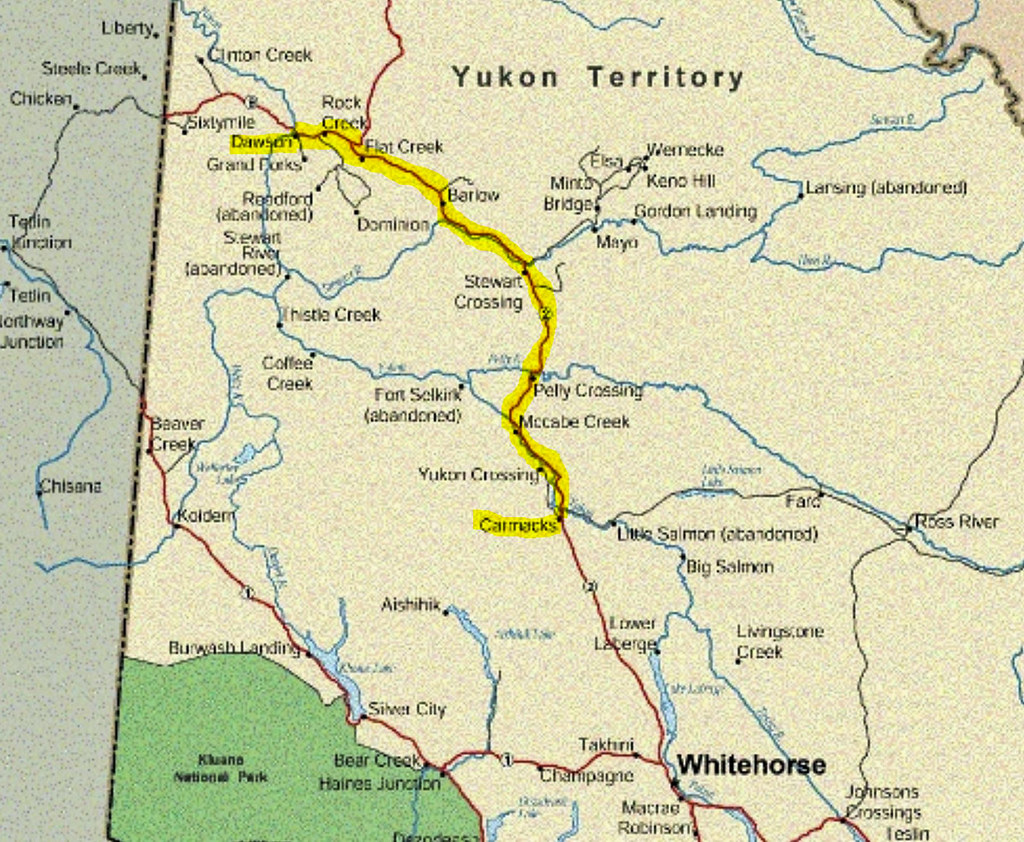
Our drive from Dawson City to Carmacks is highlighted in yellow. (the other red road from Whitehorse to Beaver Creek) is the Alaskan Highway that we came up on at the beginning of the trip.

Day 76_Dawson CityIMG_1844

We pulled out of Dawson City and didn’t get very far when Becky said “didn’t we need to get gas before we left”? So we turned around and went back to this gas station. $236 (Canadian) for 107 Liters (28 gallons). Walk in and tell the cashier how much and that’s what they charge. They have no idea what is on the pump. Very trusting. The old gas pumps are from back in the days when attendants pumped gas and made change for cash payments. Thanks to Starlink they can now run a credit card. That’s about $8.40/gallon Canadian or $6.00/gallon US.

Day 79_Dawson City to Carmacks_DAD4358

Stunningly beautiful mountainscapes. Absolute wilderness seemed to stretch forever.

Day 79_Dawson City to Carmacks_DAD4359

Beautiful mountains and a cool lenticular cloud

Day 79_Dawson City to CarmacksUntitled_Panorama-1

Panorama of the Tintina Trench area. It is impossible to describe the beautiful landscapes along the drive.

Day 79_Dawson City to Carmacks_DAD4342

I had never heard of the Tintina Trench that runs generally along the route we were traveling. Two sections of earth, 620 miles long, have slide 270 miles along this faultline/trench.

Day 79_Dawson City to CarmacksIMG_1880
Day 79_Dawson City to CarmacksIMG_1881
Day 79_Dawson City to CarmacksIMG_1879

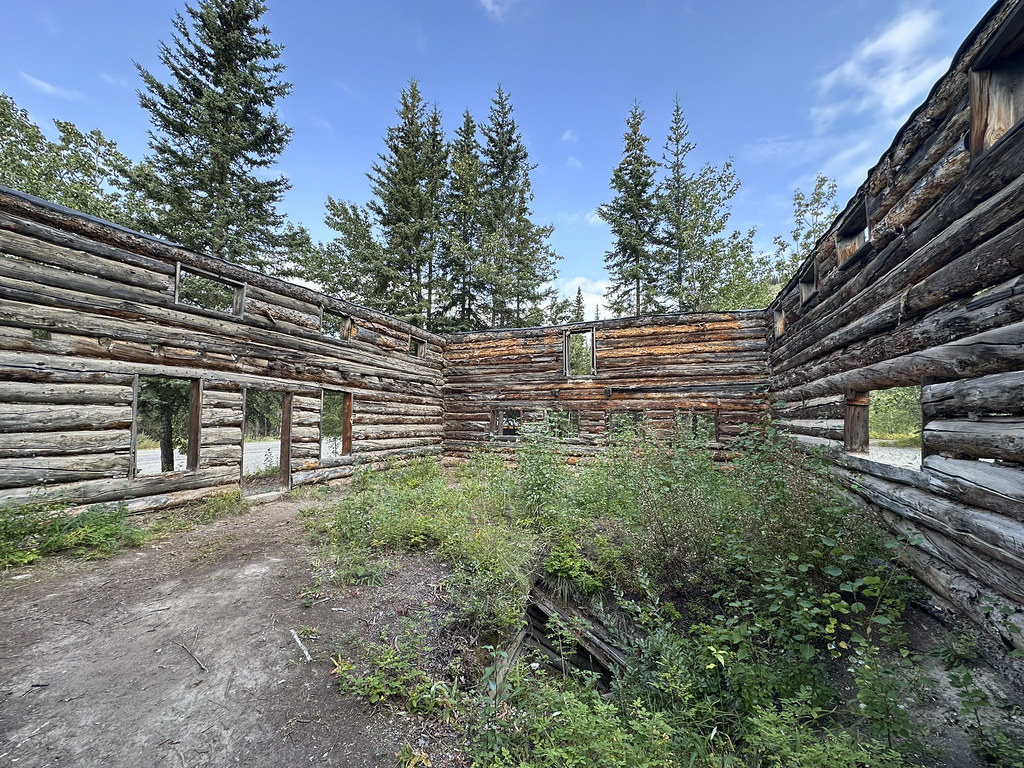
Remains of an old Roadhouse on the Overland Trail. Roadhouses amounted to civilization and safety for early travelers. Roadhouses were an interesting part of the trip. Imagining travelers on foot or dogsleds, then early trucks and automobiles brought some of the history to life. People were a lot tougher back then.

Day 79_Dawson City to CarmacksIMG_1851

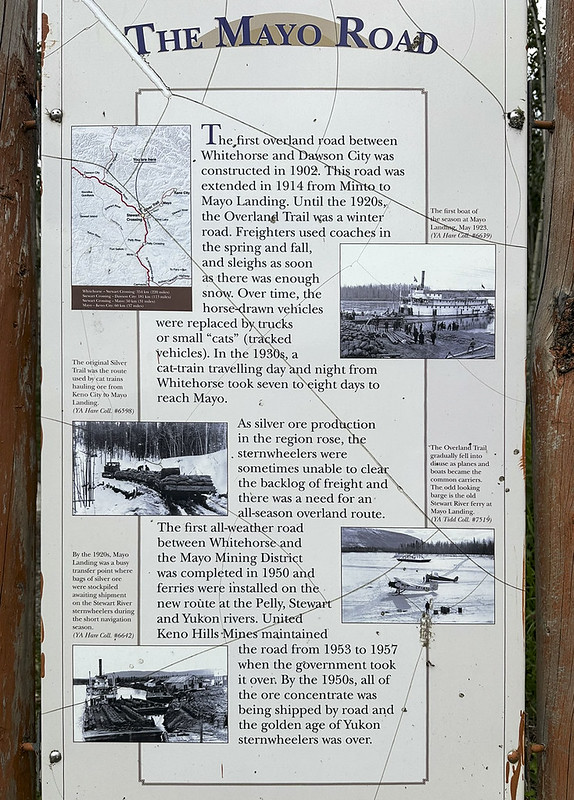
We stopped for a break at Steward Crossing. This sign explains that the first road from Whitehorse to Dawson City was completed in 1902. It was called “The Overland Trail” and was only a “winter road” until the 1920’s. Throughout Alaska and Yukon that was a familiar comment even today-that getting around on frozen ground is more practical than the muddy summer months.

Day 79_Dawson City to CarmacksIMG_1878
Day 79_Dawson City to CarmacksIMG_1877

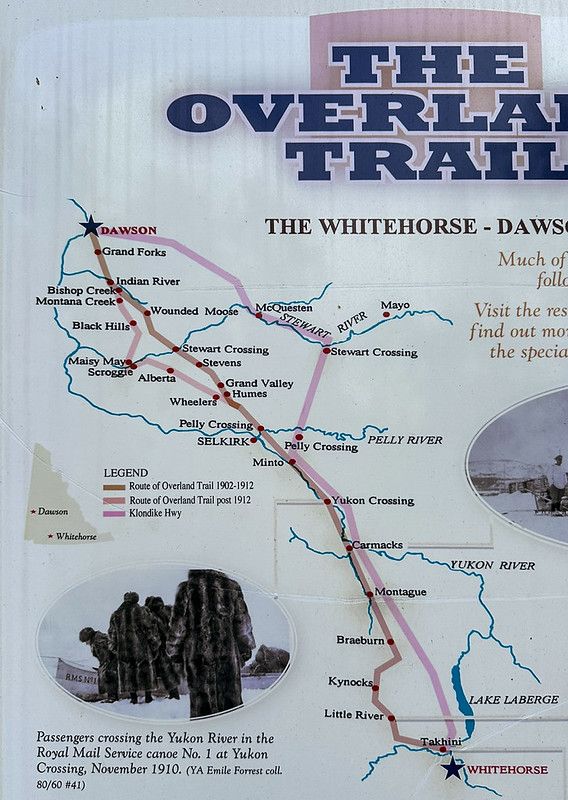
More on the Overland Trail and how the path of the trail changed over time.

Day 79_Dawson City to CarmacksIMG_1854

Overlook at Pelly Crossing.

Day 79_Dawson City to CarmacksIMG_1855

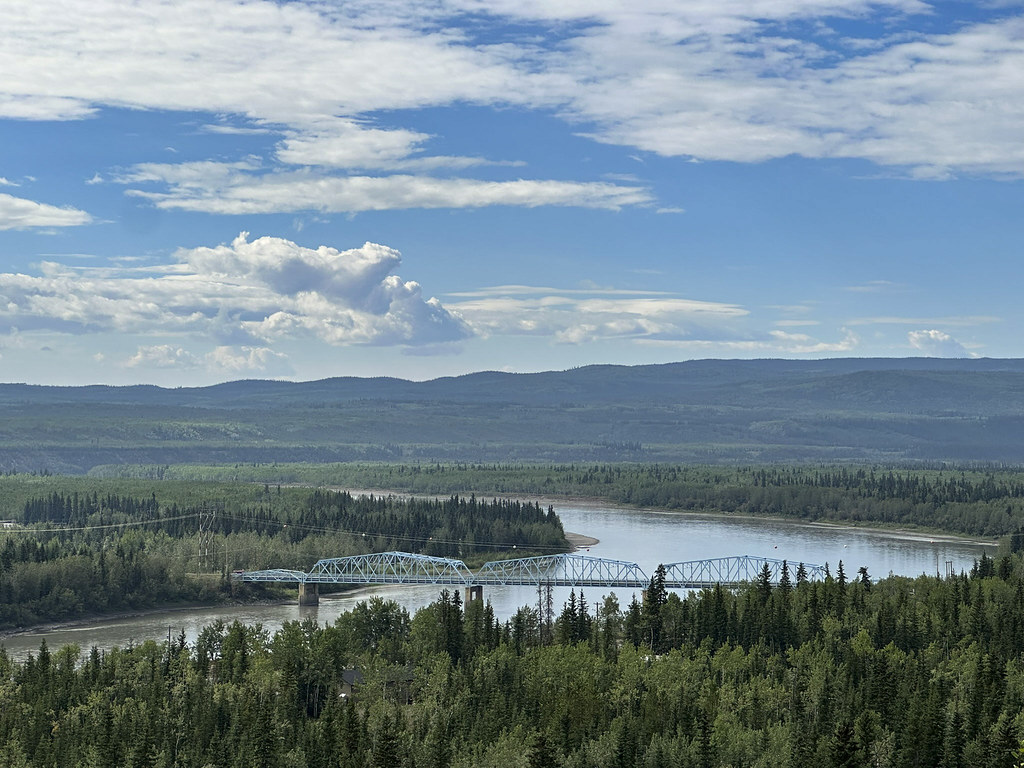
The bridge at Pelly Crossing (crossing the Pelly River).

Example of driving the Klondike Highway (the old Overland Trail) where bad pavement turns into rough gravel. We slow way down in the RV but Alaskan drivers speed right on by… By “pavement” I don’t mean asphalt. Much of what looks like asphalt is very compacted and smooth graded oiled gravel.

Example of “road construction” seems more like road “destruction”. The relatively smooth oiled gravel road is being ripped up with a spike-toothed harrow followed by a disc harrow to break up the road and remake it-hopefully smoother.

Day 79_Dawson City to CarmacksIMG_1866
Day 79_Dawson City to CarmacksIMG_1867
Day 79_Dawson City to Carmacks_DAD4361

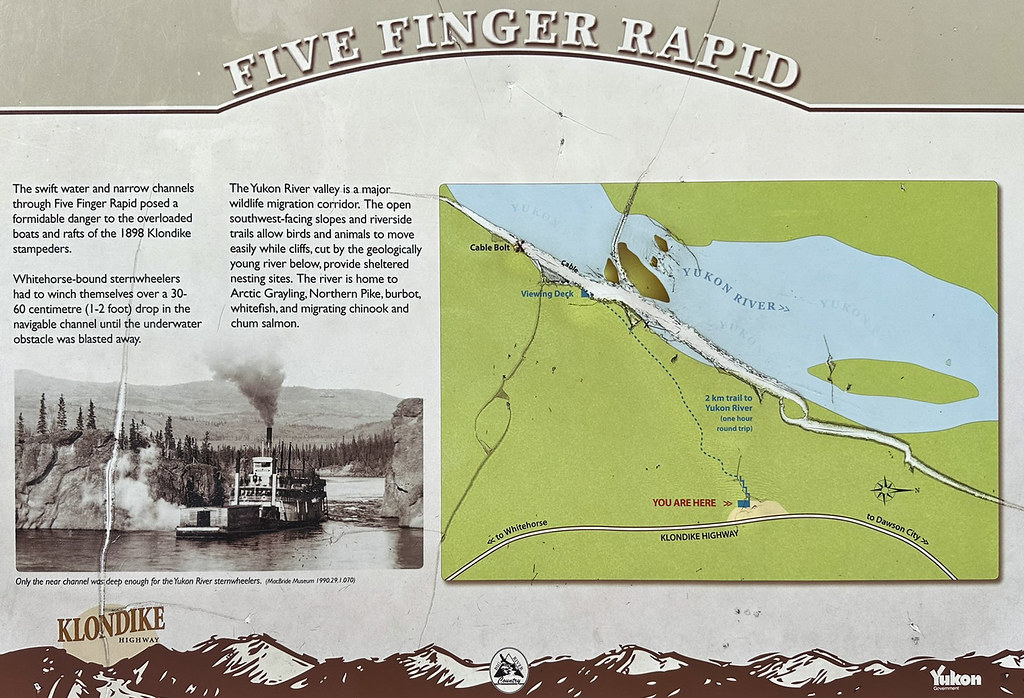
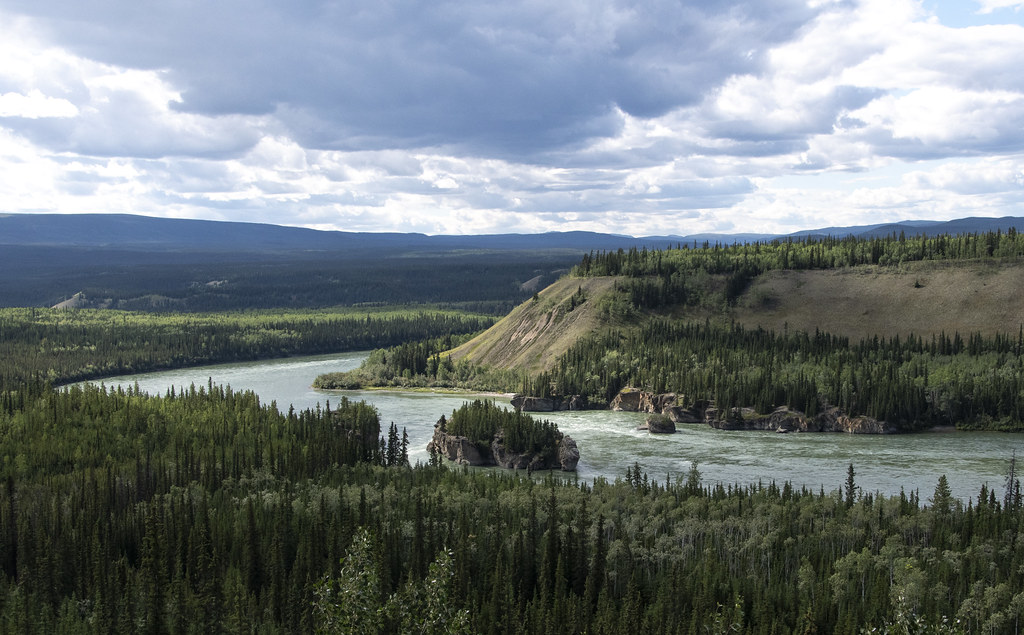
Five Fingers Rapids on the Yukon River was a difficult obstacle for early river travelers.

Day 79_Dawson City to CarmacksUntitled_Panorama-2

Closeup of Five Fingers Rapids. The water really shoots through here and was probably more exciting before some of it was blasted away to make river boat travel easier.

Day 79_Dawson City to CarmacksIMG_1862

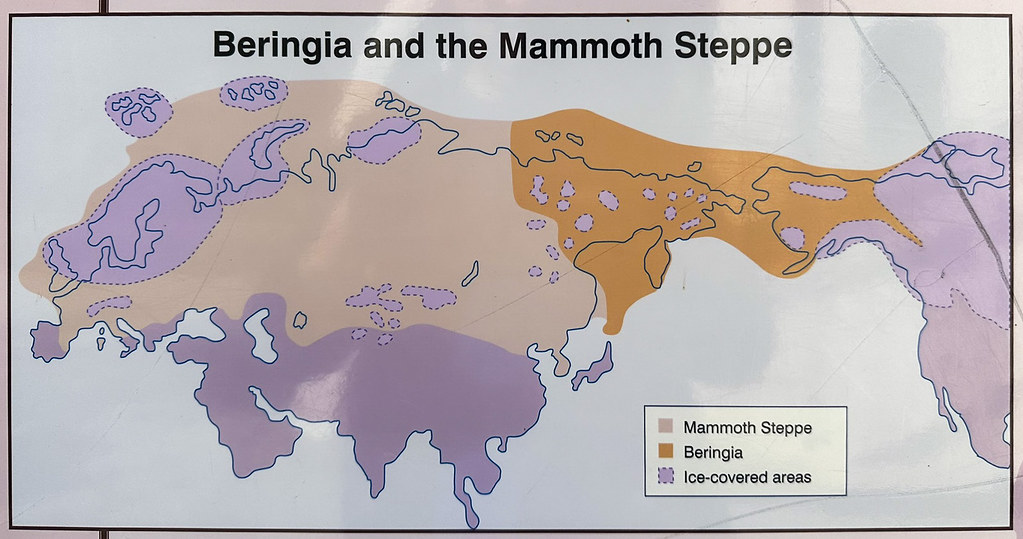
This map of glaciation as we neared Carmacks was a reminder of our visit to Beringia Centre early on the trip when we were first in Whitehorse.

Day 79_Dawson City to CarmacksIMG_1863

The orange showing area that was dry ground not covered in ice when oceans were lower and ice covered the purple areas.

Day 79_Dawson City to CarmacksIMG_1873

Our campsite at Carmacks was right alongside the Yukon River. That’s the Yukon River Bridge.

Day 79_Dawson City to CarmacksIMG_1874

Nice rainbow after some sprinkles passed over.

Day 79_Dawson City to CarmacksIMG_1876

There was supposed to be Northern Lights visible the night we were in Carmacks. It was cloudy when I got up to look. I don’t know if the green in this pic is from Northern Lights above the clouds or not? (I like to imagine it is).

The next day we traveled 115 miles to Whitehorse. No pictures. We were looking forward to not driving on bad roads and staying in one spot for three nights. The RV and the tow car were covered in mud. The Whitehorse RV Park had an RV wash area and an area to change oil; both badly needed and accomplished. The next morning we took a bus and train to visit Skagway (Alaska) which will be the next post.

Dawson City, “The City of Gold” – August 15-18

Alaskan Adventure: Days 76-79. An incredible city, with an incredible history.

Before the Klondike Gold Rush began in August 1896, Dawson City did not exist as a town; the site along the Yukon River, at the confluence of the Klondike River, was primarily a seasonal salmon-drying and fishing camp used by the Indigenous Trʼondëk Hwëchʼin First Nation (full time population-zero). By winter of that same year, about 500 gold seekers were settling into the town that Prospector Joe Ladue and merchant Arthur Harper staked out on the river mudflats. For the next 2 years the fledgling city would explode to 17,000 people at it’s height.

Below is a 1901 picture of a Hotel, Photography Studio, and Hardware store on 3rd Avenue. The photo below that is their condition today. Built on frozen ground (permafrost) the footings have settled down into the old mucky river mud.

Day 76_Dawson City_DAD4291
Day 76_Dawson City_DAD4289

The 3rd Avenue Hotel, Photography Studio, and Hardware Store today.

Day 76_Dawson City_DAD4292
Day 76_Dawson City_DAD4293

Other old buildings around town.

Day 76_Dawson City_DAD4286
Day 76_Dawson City_DAD4285

The old Post Office has been completely rebuilt and is beautiful inside.

Day 76_Dawson City_DAD4275
Day 76_Dawson City_DAD4272

Saint Andrews is still standing but just barely. Sad to see these historic places crumbling but at the same time it gives visitors a chance to feel the history of this place.

Day 76_Dawson City_DAD4276
Day 76_Dawson CityUntitled_Panorama-1

Saint Andrews today.

Day 76_Dawson City_DAD4295
Day 76_Dawson CityIMG_1735

The streets throughout Dawson City remain dirt (and mud the morning we first visited was rainy), but much of the wooden sidewalks are replaced and many buildings are new or restored to fit the character of Old Dawson City.

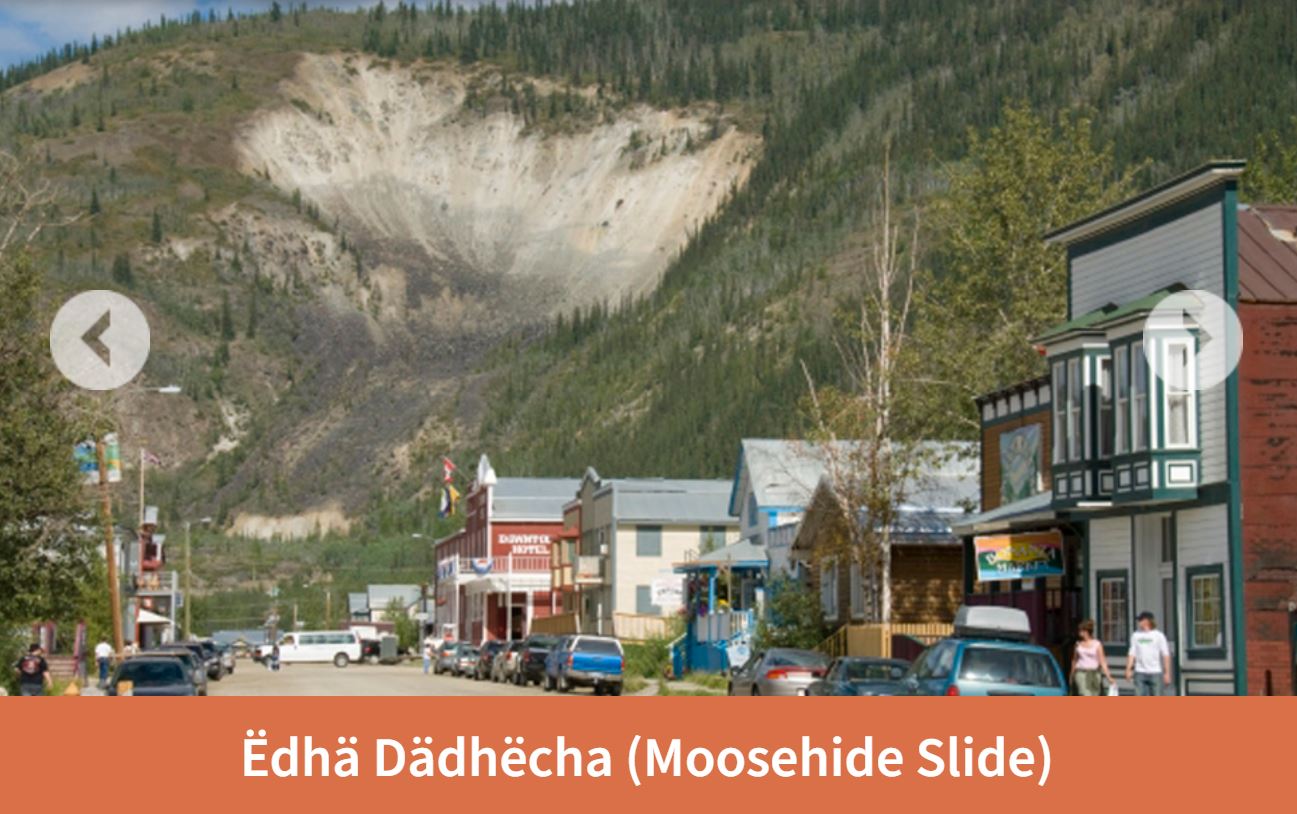
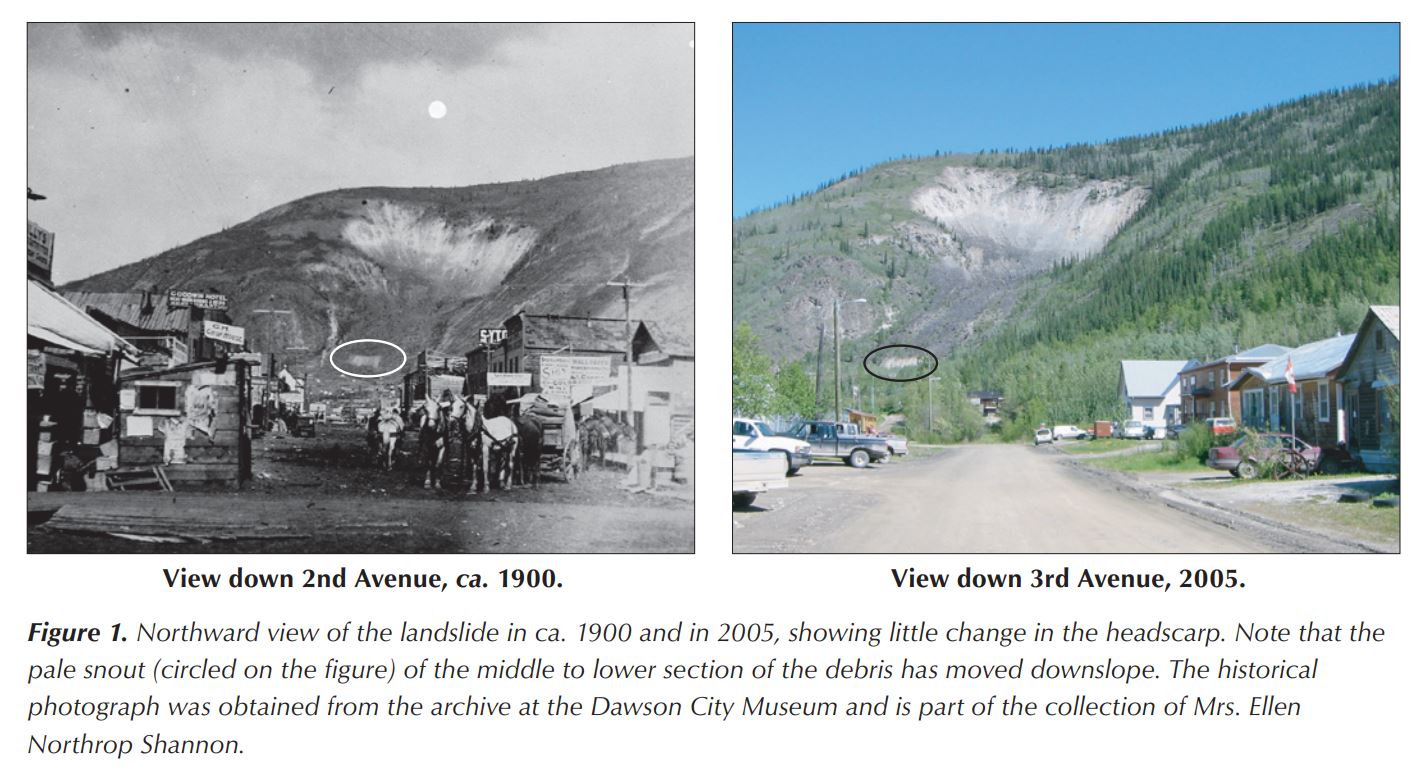
The scar on the mountainside seen on the photos above and below is a landmark feature of Dawson City. It is at the north end of the city which is also where the ferry operates so it is very prominent while waiting to cross the river and at the landing on the Dawson City side. The locals call it “Moosehide Slide”. It is known as Ëdhä Dädhëcha by the local Tr’ondëk Hwëch’in First Nation, meaning “Weathered Moosehide Hanging”.

Interesting photos about 100 years apart of the landslide. Also interesting that in 1900 ALL the trees had been cut down for the town, the sternwheeler ships, and fuel for winter heating.

Red line on the West Dawson side of the Yukon River is the Top of the World Highway ending at the ferry landing on the west side. The Klondike River originally ran on the south side of the valley. Gold dredge mining and mine tailings moved the river to the north side of the valley. The two screenshots above were found at this website: https://emrlibrary.gov.yk.ca/ygs/yeg/2006/2006_p123-138.pdf

Day 76_Dawson CityIMG_1767

Dawson City illustration 1903, before dike along the river and before gold dredges in the Klondike River Valley.

Since 1898 there have been 22 recorded floods of Dawson City. The floods typically occur in the spring with high meltwater during ice breakup. 1979 was one of the worst. The city tried but failed to keep the water out with a sandbag dike along the Yukon and Klondike rivers. Following that flood a permanent 2 meter high dike was built along the river. The top of the dike is a walking path.

Day 76_Dawson CityIMG_1736

Inside the Red Feather Saloon

Day 76_Dawson CityIMG_1784

Old photo of the Red Feather Saloon.

Day 76_Dawson CityIMG_1734

Inside the British North America Bank.

Day 76_Dawson CityIMG_1746
Day 76_Dawson CityIMG_1744

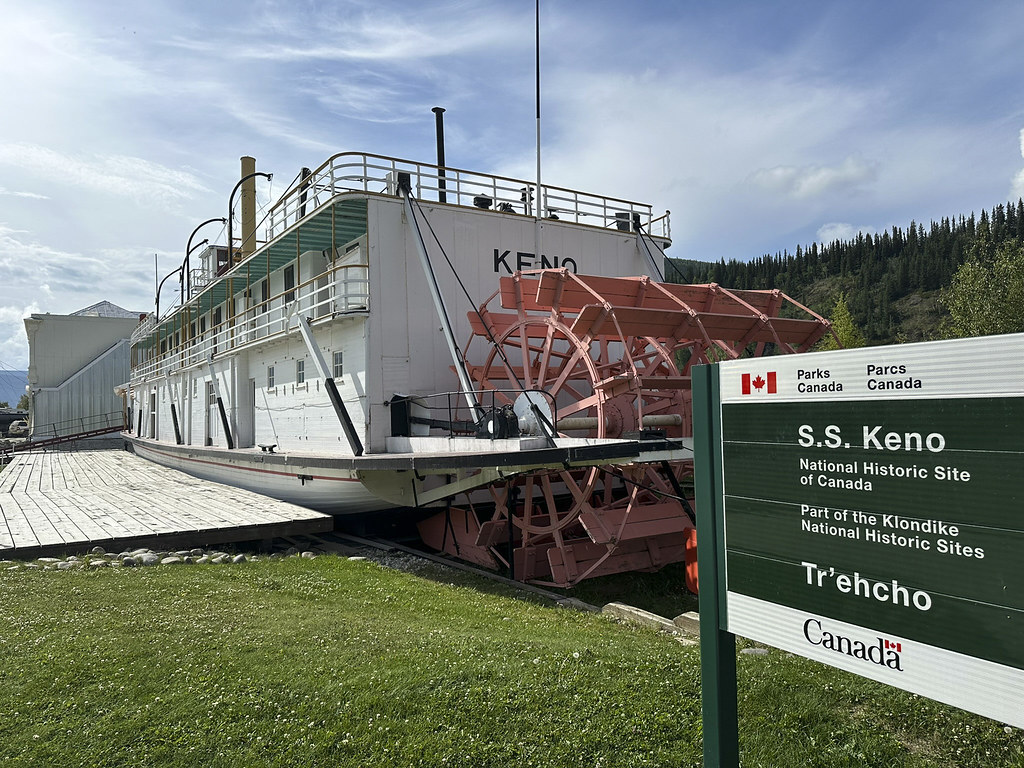
It’s hard to tell in the photos but the S.S. Keno is placed on top of the dike between the Yukon River and Front Street.

Day 76_Dawson CityIMG_1733

This Sternwheeler was built in Whitehorse in 1922. It was primarily used to haul silver-lead concentrate and had only a 2′ deep draft to navigate shallow rivers. It was retired in 1951.

Day 76_Dawson CityIMG_1843
Day 76_Dawson CityIMG_1842

We learned that the reason the ferry was so busy on the Friday we arrived was because of people arriving to participate in the Dawson City Annual Discovery Day Parade and other festivities.

Day 76_Dawson CityIMG_1738

Robert Service lived and wrote much of his prose (he did not want it called poetry) in Dawson City. We visited his cabin which still remains.

Day 76_Dawson CityIMG_1750
Day 76_Dawson CityIMG_1758

Robert Service cabin.

Day 76_Dawson CityIMG_1749
Day 76_Dawson CityIMG_1751

Inside the cabin.

Day 76_Dawson City_DAD4283

View looking down into Dawson City from the uppermost street on the mountainside. The Robert Service cabin is up on that street.

Day 76_Dawson City_DAD4279
Day 76_Dawson City_DAD4280

The old cemetery, with wooden headstones, is also up on the mountainside street.

Day 76_Dawson CityIMG_1790

A Dawson City tragedy in 1918. The Lynn Canal is a natural glacially carved fjord (not a manmade canal). It is over 2,000 feet deep; the deepest in North America except for Greenland. Becky and I were on a cruise ship to Juneau in 2018 and on a tour boat just weeks ago when we sailed from Haines to Juneau and back on the Lynn Canal…

Day 76_Dawson CityIMG_1783
Day 76_Dawson CityIMG_1777
Day 76_Dawson CityIMG_1780
Day 76_Dawson CityIMG_1782
Day 76_Dawson CityIMG_1775
Day 76_Dawson CityIMG_1773
Day 76_Dawson CityIMG_1776
Day 76_Dawson CityIMG_1772
Day 76_Dawson CityIMG_1770

Dawson City Museum had lots of info on gold rush days and early days in Dawson City.

Day 76_Dawson CityIMG_1771
Day 76_Dawson CityIMG_1769
Day 76_Dawson CityIMG_1768

Interesting food choices.

Day 76_Dawson CityIMG_1789

Shave and a haircut, two bits…

Day 76_Dawson CityIMG_1838

Jack London’s Cabin. We visited the Jack London Museum.

Day 76_Dawson CityUntitled_Panorama-7

Inside one half of Jack London’s cabin. The other half of the cabin is in Jack London Square in Oakland, California. London had carved “Jack London, miner author, Jan. 27, 1898” into the back wall logs of his cabin in 1898. There is a fascinating story about this cabin that you can read about here: https://jacklondonmuseum.ca/wp-content/uploads/2016/12/Jack-London-Cabin-updated-Dec-5-ks.pdf

Day 76_Dawson CityIMG_1830
Day 76_Dawson CityIMG_1831
Day 76_Dawson CityIMG_1832

List of books by Jack London and some local history on his famous “Call of the Wild” book and the dog “Buck”.

Day 76_Dawson CityIMG_1833

Historic incident that inspired the Jack London book “The Unexpected”

Day 76_Dawson CityIMG_1836

Another historic incident that was included in Jack London’s boo “The League of Old Men”

Day 76_Dawson CityIMG_1837
Day 76_Dawson CityIMG_1835
Day 76_Dawson CityIMG_1834

Couple of paintings I liked at the Jack London Museum. They are both of his cabin and food cache.

Day 76_Dawson CityIMG_1826
Day 76_Dawson CityIMG_1825

We ate dinner with Mike and Amy at Sourdough Joe’s. The fish was delicious and we somehow didn’t get rained on.

Day 76_Dawson CityIMG_1824
Day 76_Dawson CityIMG_1823

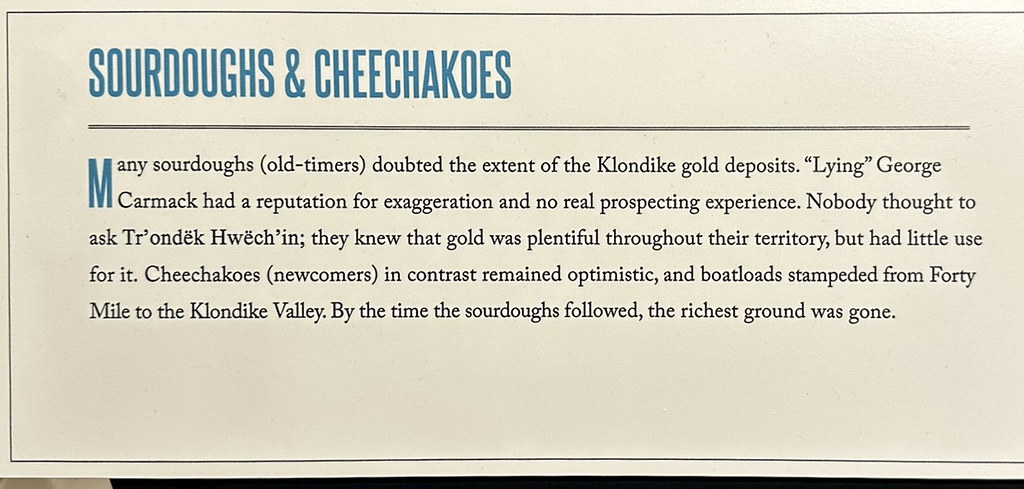
Sourdough Joe’s menu has interesting early days history of Dawson City. Here’s a link to a Park’s Canada website with lots of early history of the early gold rush days: http://parkscanadahistory.com/series/chs/26/chs26-1g.htm

Individual miners quickly exhausted the surface gold. In only a few years their individual claims were bought up by large corporations. The corporations funded huge dredging machines that could only be profitable with large tracts of land processing tons of gold bearing gravel.

Day 76_Dawson CityIMG_1828

Model of a gold dredge in the Dawson City Visitors Center

Day 76_Dawson CityUntitled_Panorama-5

The real thing. We toured Historic Gold Dredge No.4; the largest wooden-hulled bucket-line gold dredge in North America.

Day 76_Dawson CityIMG_1792
Day 76_Dawson CityIMG_1803

Our tour guide describing how the dredge worked and some of the steel pieces used to “stratify” or separate the gold from the gravel the dredge brought up. The fiber mat is the last step. The heavy gold would settle into the mat and be collected from there.

Day 76_Dawson CityIMG_1802

Buckets of Gold

Day 76_Dawson CityIMG_1812
Day 76_Dawson CityIMG_1805
Day 76_Dawson CityIMG_1804
Day 76_Dawson CityIMG_1793

Huge direct current electric motors drove all the machinery.

Day 76_Dawson CityIMG_1795
Day 76_Dawson CityIMG_1794

Huge gears made intense screeching and grinding noise. No grease or oil was used because gold is strongly attracted to grease and oil. Gold flakes coated in oil would float or attach to bubbles and not settle by gravity to be captured. The noise from the gravel and metal working through the dredge could be heard constantly from miles away. Most dredge workers were deaf or very nearly deaf.

Day 76_Dawson CityIMG_1801

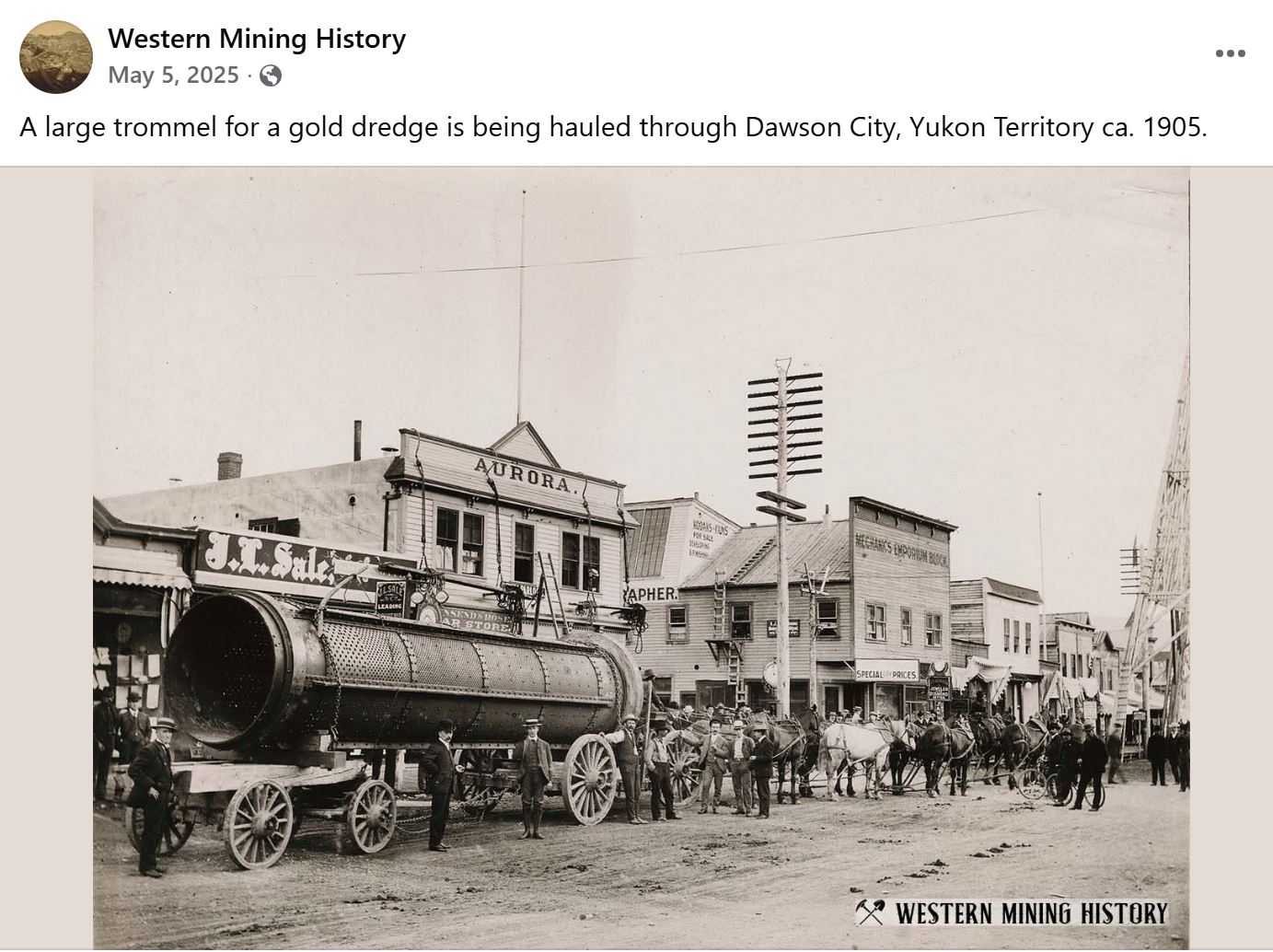
View looking into the “trommel”. One of the last stages of gravel/gold separation. The gravel that was dredged up has already been washed and the big rocks removed. The wet washdown gravel and sand was fed into this trommel which had water being sprayed into it by the pipe in the center. The heavy gold bits washed down out of the trommel while the rocks got fed out the back of the dredge.

A better view of a gold trommel in Dawson City

Day 76_Dawson CityIMG_1797
Day 76_Dawson CityIMG_1796

This is the “front” end of the dredge, where the chain of buckets dig down to the bedrock where gold has settled. The “Control Room” with rows of levers control the movements of the dredge. The Control Room is the only place on the dredge with heat. The dredges ran continuously 24/7. Only stopping to clean out the gold from the fiber mats.

Day 76_Dawson CityIMG_1761

Our RV tour included a trip to “Diamond Tooth Gerties Gambling Hall”. Canada’s oldest licensed gambling hall. Gertie was a real historical person from gold rush days with a diamond mounted between her front teeth.

Day 76_Dawson CityIMG_1760
Day 76_Dawson CityIMG_1762

Wintertime mural painting of miners crossing a mountain pass and Dea (blue t-shirt and pants) from our group on stage with the cancan girls.

Day 77_Dawson CityUntitled_Panorama-2

Mike and Amy drove us up the “Dome Road” in their truck, to the “Midnight Dome Viewpoint”. The viewpoint overlooks the Yukon River, Dawson City, and the Klondike River Valley which flows into the Yukon from the left in this view.

Day 76_Dawson CityIMG_1765

Tourists

Day 77_Dawson CityUntitled_Panorama-1

A view that includes more of the Klondike River Valley extending to the left. It is hard to appreciate how much gold mining, especially gold dredging, has destroyed the valleys. The “Gold Dredge No. 4 Historic Site” is up the valley on the far left of photo.

Day 77_Dawson City_DAD4333

Photo zoomed in from the Midnight Dome Viewpoint. Mounds of gravel dredge tailings in what was the Klondike River Valley in the foreground. The washout from dredging operations up the Bonanza Creek Valley in upper left.

Day 77_Dawson CityDredging Dawson Creek

This is a screenshot from Google Maps of the Klondike Valley leading into the Yukon River at Dawson City. The serpentine mounds of gravel left from dredging operations cover the valley. The tour guide described dredging as “turning the valley upside down”. Most of the gold settles as far down as it can go which is at the bottom of all the sand and gravel of the creek/river. The goal of the big dredge buckets was to go down to “bedrock”. The buckets teeth were replaced frequently as they gouged out the bedrock to get the gold that had settled down there.

Day 77_Dawson CityUntitled_Panorama-4

View at sunset looking the other direction on Midnight Dome Viewpoint was beautiful.

Favorite Bible verse of the day: Hebrews 11:3

“By faith we understand that the worlds were prepared by the word of God, so that what is seen was not made out of things which are visible.”

Top of the World Highway: from Chicken, Alaska to Dawson City, Yukon – August 14

Alaskan Adventure: Day 75. We only traveled 110 miles from Chicken, Alaska to Dawson City, Yukon but what a day.

The Taylor Highway; which we traveled from Tok to Chicken, turns north shortly after passing through Chicken and goes to Eagle (another historic gold rush town). The “Top of the World Highway” is the road from Chicken to Dawson City. Everyone had told us this would be the worst road we traveled. They were right. Except for two spur roads running north to Arctic settlements (the Alaskan Dalton Highway from Fairbanks to Prudhoe Bay and the Yukon Dempster Highway from Dawson City to Inuvik) the Top of the World is the northernmost Highway in North America and in most of the World.

The “Top of the World” name is due to the road following the ridges of mountains instead of following the river valleys which is far more common. Much of the road, especially from the border of Yukon/Canada is above the tree line. We were glad it was not a windy day. Not for the faint of heart, there are virtually no guardrails or centerlines anywhere, the road is mostly dirt, and narrow. Some of the drop-offs on the edges are quite scary. For our own memory, lest we forget, we have included lots of video of driving this road. If you bother watching any of these, you may hear the dashcam system say “Video Protected” and several beeps. The systems thinks we’ve been in an accident… I have hundreds of protected videos from this trip.

This dashcam video is from about 9:35am Alaska time.

This is from 11:42am Yukon Time (10:42 Alaska Time). Shortly after passing through Canadian Customs. The name of the border crossing is “Poker Creek-Little Gold Creek”. It is only open during daylight hours in the summer. The entire road is closed for winter on September 15. Nobody travels this road in the winter, even in a snow machine because of the treeless exposure, high winds, and extreme cold.

Day 75_Chicken to Dawson City_DAD4266

Random: We stopped at a pull-over soon after crossing the border into Yukon and saw this brilliant red bird. This is a male White Winged Crossbill. They use their specialized “crossed-bill” beaks to pry open spruce and tamarack cones of the boreal forest.

This is from 12:03pm Yukon Time. This “Top of the World Highway” was originally a route used by indigenous peoples because it offered easier travel than hacking through dense valley brush. In late 1890’s gold miners used parts of the path to become pack mule trails. in early 1900’s it was upgraded into a wagon road. Continued upgrades and extensions in 1930’s led to the current “gravel highway” opening in 1955.

This is from 12:07pm. Beautiful scenery, scary road.

This is from 1:57pm. “Top of the World”

This is from 2:13pm.

This is from 2:44pm.

FullSizeRender-2

Another good example of why it’s called “Top of the World” Highway. Following the ridges instead of the valleys. That’s our RV and little tow car trudging up the mountain.

FullSizeRender-4

Driving in the dirt.

Quick video of us and our cloud of dust driving “Top of the World” Highway. Video by our group tail gunners who were following us near the end of the trip. We didn’t leave last from Chicken this morning but by the end of the day everyone else had passed us.

Day 76_Dawson CityIMG_1723

Finally, at the end of the 110 mile road there was a big waiting line. Dawson City is on the other side of the Yukon River. The ONLY way to cross the river is by ferry. Called the “George Black Ferry”, there is no charge. The ferry operates as an extension of the Yukon Highway System. There are no reservations. It runs 24hrs, every day, on a first come, first served basis. Stopping and waiting (for several hours) gave us a chance to check out how dusty we had gotten. The next photos cover that.

Day 76_Dawson CityIMG_1732
Day 76_Dawson CityIMG_1716
Day 76_Dawson CityIMG_1713
Day 76_Dawson CityIMG_1731
Day 76_Dawson CityIMG_1730

A look under the hood of our tow car. What a mess. We had mesh screen between the RV and the tow car that did a good job of keeping rocks off the windshield of the car but didn’t do anything about all the dust billowing out from the RV getting up into the engine compartment of the tow car. The car started fine but looked like a Charlie Brown – Pigpen scene with dust blowing everywhere. We kept wondering what our mechanic friend back home would think of what we were doing (and wishing he were here). One of the members of our RV group had a leaf blower which helped immensely with cleaning this up.

Day 76_Dawson CityIMG_1722

There is not much on the west side of the Yukon River but there are a few things. West Dawson was settled in 1899 by people wanting to avoid the overcrowding and typhoid outbreaks from all the gold seekers crowding into Dawson City.

Day 76_Dawson CityIMG_1717
Day 76_Dawson CityIMG_1719

We took some pics while waiting our turn. This trip had 5 vehicles and 2 RV’s on it. The black RV with the blue sticker on the back is one of our group.

The first part of leaving shore is crazy. It seems like the ferry and everyone on it will be swept downstream. The Yukon River is already a big powerful river at Dawson City.

This is our friends Mike and Amy driving their big beautiful rig onto the ferry.

Finally, it was our turn to cross. This dashcam video is from 7:08pm when we finally drove onto the ferry to cross the Yukon River to Dawson City. This was about 10 hours after leaving Chicken this morning (6 hrs to drive 110 miles and 4hrs waiting for the ferry).

Video from my phone as we crossed the Yukon.

FullSizeRender

Photo by Lori of us crossing the Yukon.

Sitting in our RV while on the ferry crossing the Yukon River was a unique experience. This video (and the next one) was taken by Lori. Joe and Lori were our tour group “tail gunners”. They were trying to be the last ones to cross on the ferry but they got called up before us. We were glad they went next-to-last and we were last and that they took videos! Thanks Lori.

Driving off of the ferry was rough but we made it. Nothing here is paved, just gravel with big ruts. The same gravel ramps are used to access the frozen Yukon River in winter.

Some Yukon River Trivia: The Yukon River is 2,000 miles long and is the longest free-flowing river on the North American continent (two others are longer but are composites of several rivers; Jefferson-Missouri-Mississippi). The Yukon has only one dam (at Whitehorse). There is only one bridge over the Yukon River in the entire State of Alaska. The entire (huge) State of Alaska and parts of Canada drain into the Yukon River Basin.

We have arrived in Dawson City. We wondered at times if we would make it. A driving and ferry experience we will long remember and will probably never repeat. The next post will be about our stay in Dawson City for 4 nights at “Bonanza Gold Motel & RV Park”.

Favorite Bible reading verse for today: 1 Timothy 1:15-17

Apostle Paul:
It is a trustworthy statement, deserving full acceptance, that Christ Jesus came into the world to save sinners, among whom I am foremost. Yet for this reason I found mercy, so that in me as the foremost, Jesus Christ might demonstrate His perfect patience as an example for those who would believe in Him for eternal life. Now to the King eternal, immortal, invisible, the only God, be honor and glory forever and ever. Amen.

Valdez to Tok & Tok to Chicken – August 12-13

Alaskan Adventure: Days 73 & 74. We traveled 253 miles from Valdez to Tok for a one night stay at Sourdough Campground. The next morning we set out for Chicken on the Taylor Highway. It is only 66 miles from Tok to Chicken but much of it is a long, slow, bumpy, dusty road! The next morning we set out for Dawson City, also nicknamed “the City of Gold”. That highway is called “Top of the World”

August 12: We wished we had another day in Valdez instead of a long drive back over some roads we had already traveled. Leaving Valdez was sort of sad because it felt like “the beginning of the end” of our Alaska trip. We still had two weeks left but Valdez was the last overnight stay along the beautiful Alaska coast. From Valdez back to Glennallen on the Richardson Highway was a repeat but from Glennallen to Tok was new road. The next several pics are of travel to from Valdez to Tok.

Day 73_Valdez to TokUntitled_Panorama-2
Day 73_Valdez to TokUntitled_Panorama-1

Had to stop again to take pics as we went past the beautiful mountain ranges of Wrangell-St. Elias National Park.

Day 73_Valdez to Tok_DAD4144

We stopped along the road to watch Trumpet Swans in a pond.

Day 73_Valdez to Tok_DAD4128
Day 73_Valdez to Tok_DAD4149
Day 73_Valdez to Tok_DAD4158

Trumpeter Swans were once considered endangered but have made a comeback. Vibrant red something growing nearby.

Dashcam video. Nothing particularly special, just a reminder of the beauty of traveling the Richardson Highway from Valdez to Tok.

We only stayed one night in Tok, at the same campground (Sourdough) we had stayed at earlier in the trip on the way into Alaska. Now we were headed out of Alaska.

August 13: The drive from Tok to Chicken was one of the shortest milewise but one of the longest timewise. Lots of washboard dirt road. The scenery was great but couldn’t look at it very long because you had to watch the road. Try to speed up a bit then hit the brakes when the washboard starts up again and the RV dashboard starts bouncing. Only 77 miles but we only averaged about 10mph. The first and only town between Tok and Chicken is called Tetlin Junction. From there on, mostly north, for 65 miles there is literally nothing but Alaskan wilderness and dirt road. Beautiful but kinda scary.

Tok to Chicken

Wild mountain scenery from Tok to Chicken.

Moose5_DAD4164
Moose4_DAD4229

We got to see MOOSE finally! They were in a pond, right alongside the dirt road. Seeing this made the bad road seem more worthwhile.

Moose3_DAD4218
Moose_DAD4186
Moose2_DAD4203

Hated to leave this spot watching the moose but we were stopped right in the road and close to a one lane bridge so we eventually had to move on. Only one car came by during the 20 minutes we were there which gives you some idea of how remote this is.

Day 74_Tok to ChickenIMG_1673

A paved pullover area for a break and to read information signs.

Dashcam – driving the Taylor Highway. Driving these roads will be a memory that sticks. It may not seem difficult to watch the video but to dodge and weave for hours took a lot of concentration. We were all worn out by this road.

Where bad pavement meets bad dirt and washboard.

Day 74_Tok to ChickenIMG_1664
Day 74_Tok to ChickenIMG_1671
Day 74_Tok to ChickenIMG_1670

There are places you can stop and pan for gold. This location was protected by hordes of mosquitos.

Day 74_Tok to ChickenIMG_1665

Not a great sign but shows the Taylor Highway which continues on north to Eagle and where it splits off east to become the Top of the World Highway and cross the border into Canada. Continues on to Dawson City where it crosses the Yukon River.

Day 74_Tok to ChickenIMG_1666

Took this mostly for the “You are Here” note and how far north toward the Arctic Circle we were. Chicken and Dawson City are only about 170 miles from the Arctic Circle (straight line, about 600 miles driving).
The Great Northern Forest (green): Called “Taigo” in Russia, the boreal (northern) forest extends around the top of the world. White and black spruce, paper birch, quaking aspen and balsam poplar are the dominant trees in Alaska’s boreal forest.

Another video of the road to Chicken. This is the Only road to Chicken. They call it a Highway. The “Taylor Highway”. Never complain about our Highways…

Day 74_Tok to ChickenIMG_1679

Entering Chicken, this is the official welcome/directions signage.

How did the town get the name “Chicken”? From the town’s own website: In the late 1800’s, early miners traveled far in search of gold. Food was sometimes scarce, but a particular area near the South Fork of the 40-Mile River was abundant in Ptarmigan, now the state bird which bears a resemblance to a chicken (Ah the foreshadowing is thicker than steel.) The miners kept themselves alive with the help of the Ptarmigan (if you consider being eaten as helping.) In 1902, Chicken was to become incorporated, the second town in Alaska to do so. The name “Ptarmigan” was suggested. Many people liked the name, but felt the quotation marks were too presumptuous. The name was shortened to Ptarmigan. The only problem was that nobody could agree on the correct spelling. They didn’t want their town name to be the source of ridicule and laughter, so they decided on “Chicken.” (The irony is thicker than the foreshadowing.)

Day 74_Tok to ChickenIMG_1694

Our campsite (way in the background) along Chicken Creek.

Day 74_Tok to ChickenIMG_1697
Day 74_Tok to ChickenIMG_1699

Chicken Creek and abandoned gold dredge.

Day 74_Tok to ChickenIMG_1704

Abandoned Pedro Gold Dredge, or F.E. Company Dredge Number 4. This dredge was originally built in California, shipped to Pedro Creek (north of Fairbanks Alaska) and assembled to mine gold in 1938. In 1959, when the gold there ran out, The Fairbanks Exploration Company took the million pound dredge apart and shipped it piece by piece to Chicken over the Alaskan and Taylor “Highways”. It mined gold on Lower Chicken Creek from 1959 to 1967. I was thinking gold mining by dredge was ancient history but I was born in 1955 and 12 years old when this thing quit running. I guess I am ancient history.

Day 74_Tok to ChickenIMG_1678

Most of our group took a walk up the hill to tour the abandoned buildings of “Old Chicken”. The short section of paved road turns into dirt at the corner ahead. It messes with your head to just start walking up “The Highway” but there is that little traffic and except for truckers mostly slow moving.

Day 74_Tok to ChickenIMG_1676
Day 74_Tok to ChickenIMG_1685

An abandoned steam shovel and our tour guide explaining the weed overgrown Old Chicken buildings. Mike Z. is checking out the door into the old “General Store”.

Day 74_Tok to ChickenIMG_1680
Day 74_Tok to ChickenIMG_1681

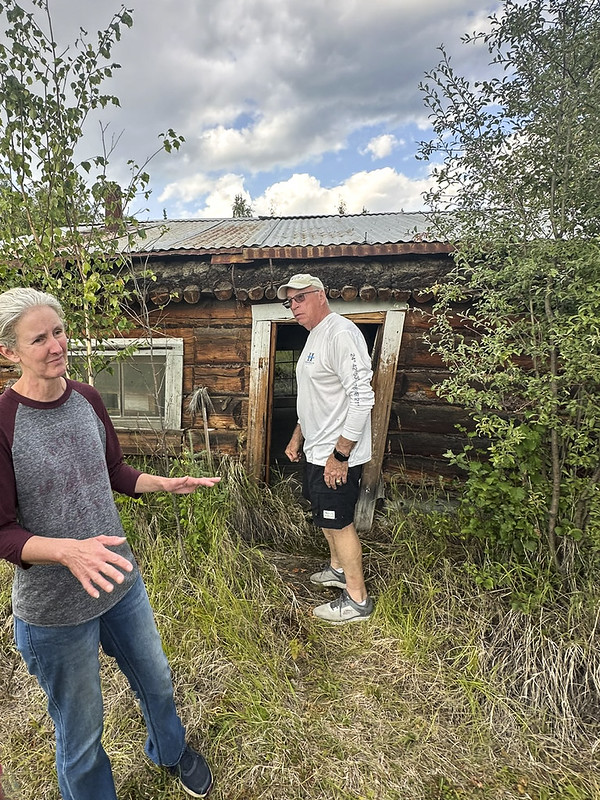
This is what remains of the “Chicken General Store”. It was owned by John Powers who is “Mr. Strong” in the book “Trisha”

Day 74_Tok to ChickenIMG_1684

I stuck the phone through the door to take this pic. The walls have sunk into the permafrost ground so far that the floor is at the windows.

Day 74_Tok to ChickenIMG_1686

This is the remains of a rather famous schoolhouse in Old Chicken. It was originally built as two stories and was the “Chicken Creek Hotel” before being converted into a one story schoolhouse. In 1927, 19 year old Anne Hobbs arrived in Chicken to teach children. She only lasted a few years before the local people ran her off because she wanted to include teaching the native Inuit children too. Inuit could not pronounce “Teacher” so they called her “Tisha”. The 1976 novel “Tisha: The Story of a Young Teacher in the Alaska Wilderness” describes her experiences.

Day 74_Tok to ChickenIMG_1687

This is the room that Anne Hobbs lived in while teaching at the Chicken School. It is about 1/3 of the school building. Below is a short autobiography she wrote. Her name changed to Anna Purdy after she married a gold miner named Fred Purdy. This was also scandalous because he was half-Inuit.

I was born around 1908 in the back country of Prownington, Missouri. I was teaching in Oregon when I was given an offer to go to Alaska to teach. I have taught in many places such as Franklin Creek (3 years), Chenin (1 year), Tetlin Indian Village or reservation, Dot Lake and Eagle (6 to 7 years). Also taught in the desert in Claifornia at 29 Palms to wayward children, and Chicken, Alaska for 10 years to ten pupils.

In Eagle I married Fred Purdy and during the following years legally adopted 10 children. Chuck, Ethel, Doris, George, Marie, Eddie, Jack, Hank, Lynn and Barbara. Fred was a miner at Meyers Fork. He died in 1965 and was buried next to Doris his daughter. I have been an assistant to the Postmaster, managed road house in Eagle and started the Eagle Library. I am a sourgough of Chicken, Alaska, part and parcel of that great land of gold. I was priviledged to know many of the early sourdoughs before my time. Paul and Jim Bytell, Dick Mitchell, Jack Hawn, Bill Smeter, freigter on river with horse sleds carrying supplies, Ben Norval a very knowledgeable prospector and also a preacher when needed.

I have written two books, “Dark Boundry” in 1954 and “Tisha” in 1976. We live off the Taylor Hwy. at the end of the road in a big yellow house.

Marie became a deep sea diver and now works in a bank at Anchorage. Barbara traveled the world over, a fine geologist, and a professional photographer, lives in Anchorage most of the time. Jack was killed in Vietnam for nothing. Big Ed, a pilot, but made more money as a truck driver in Texas. George a brilliant and now president of oil company in Houston. Ethel lives in Texas as a professional artist and Hank lives in Fairbanks. Chuck died of TB after he had grown up. I have had 4 sons in the armed services. Doris died after, over 10 years of hospitalization and Lynn lives with me spending most of her time knitting.

-Anne Purdy

Day 74_Tok to ChickenIMG_1688

This is the School Room in the other 2/3 of the building. The floor is almost to the window sills as the outside walls gradually sink into the permafrost ground.

Day 74_Tok to ChickenIMG_1705

The Chicken chicken.

Day 74_Tok to ChickenIMG_1700
Day 74_Tok to ChickenIMG_1693

Chicken chicken and a patch of fireweed with almost no blossoms left – winter is coming.

Day 74_Tok to ChickenIMG_1702

This is “downtown” Chicken. One gasoline pump covered in stickers and His/Hers public pit toilets.

Day 74_Tok to ChickenIMG_1703

These three buildings make up the entire “downtown” Chicken. All powered by gasoline generators. There are couple other separate buildings related to campgrounds. It was cool enough that we didn’t need air conditioning which was good because no 30amp was available, just a standard 110 plug-in. There a few people that live in Chicken through the winter. There is a post office that gets mail two days a week by airplane. Our tour guide explained that it is easier to get around in the winter on snow machines. It is always dark, very, very, cold and people mostly stay at home. The Taylor Highway is closed in winter so this is a lonely place.

Chicken Alaska is an odd, quirky, special, place. There’s not much here, but there’s also a lot here. It’s so inaccessible that it has not been “Disneyfied”. It’s an old gold mining town that has been almost, but not completely abandoned because the road needs a place for a few folks to stop for the night. A “ghost town” that is still inhabited. Glad to have visited but no desire to drive those roads again.

August 14: After our one night in Chicken it was time to leave for a shorter, but worse, road from Chicken, Alaska to Dawson City, Yukon Territory. Before leaving we went to the Chicken Creek Cafe for breakfast and hot Cinnamon Rolls fresh out of the oven. Thanks to Starlink they take Visa.

Favorite Bible reading verse for today: Galatians 3:29

“And if you belong to Christ, then you are Abraham’s descendants, heirs according to promise.”

Valdez Town & Museums – August 11

Alaskan Adventure: Day 72 – We toured the town of Valdez today, including the Visitors Center and several museums. Valdez was one of my favorite places. It is so “Alaskan”. It’s wild old Alaskan beauty and history is still there and it is possible to get glimpses of what people arriving in 1898 for the gold rush saw. The beauty of the wildlife in the sea and shores that we saw from the Lu-Lu Belle boat tour, the swarming masses of salmon, the work of early civil engineers to build a road through a canyon, the tragedy of earthquakes and oil spills, all combine to make this place special.

Day 72_Valdez MuseumsIMG_1626

Valdez mural honoring gold rush history.

Day 72_Valdez MuseumsIMG_1627

We were looking for a grocery store and stopped here at the local spot “The Food Cache”. This was a good reminder that things in Alaska are not like things in the lower 48. Clearly there has never been an ADA Code inspection here. I don’t have a pic inside but it was packed from floor to ceiling with narrow (like walk sideways narrow) aisles.

Day 72_Valdez MuseumsIMG_1645
Day 72_Valdez MuseumsIMG_1646

These pics are from a different grocery store in Valdez. Things are more expensive in Valdez. Gasoline was around $6/gal.

Day 72_Valdez MuseumsIMG_1619

A example of Alaskan practicality. This historic building; “The childhood home of Alaska’s first Governor Bill Egan” is a candy store.

Day 72_Valdez MuseumsIMG_1623

We stopped at the Valdez Visitors Center. We have seen and visited several historic old Roadhouses on the tour. This display of roadhouses stretching from Valdez all the way up to Fairbanks explained how important (and crude) these early ‘hotels’ were to travelers.

Day 72_Valdez MuseumsIMG_1625
Day 72_Valdez MuseumsIMG_1624
Day 72_Valdez MuseumsIMG_1622

36 Roadhouses on the 360 mile trail from Valdez to Fairbanks in 1906. Approximately every 10 miles, about as far as you could walk with baggage in a day.

Day 72_Valdez MuseumsIMG_1621

Map of original Valdez town location at the base of Valdez Glacier. The location of the town, at the base of a glacier was convenient, but crazy. Gold rush folks could get off the ship and get going to the gold fields by CLIMBING UP and OVER the GLACIER… Every spring the town would flood from glacial meltwater. Eventually they built a dike around the town to minimize flooding. These folks were hardy. Winter was considered “easier” because the rivers and lakes on the other side of the glacier were frozen so sleds replaced boats. Keep in mind the mountains in this area back then received several hundred FEET of snow each winter with high winds and temperature consistently well below zero, often negative forty and below. Much easier…

Day 72_Valdez MuseumsIMG_1620
Day 72_Valdez MuseumsIMG_1617

1898 Map of “Recent Gold Discoveries”

Day 72_Valdez MuseumsIMG_1618

Detail of Prince William Sound, Port Valdez and access to the “Gold Fields”

Day 72_Valdez MuseumsIMG_1644

This is the front entrance to the Old Town Valdez Museum. Utilitarian Architecture at it’s finest. There are two “city” museums in Valdez. This one is “Old Town Valdez Museum”, the other is “Valdez Museum” both are interesting and the rest of this post is a mix of both.

Day 72_Valdez MuseumsIMG_1598
Day 72_Valdez MuseumsIMG_1601
Day 72_Valdez MuseumsIMG_1600
Day 72_Valdez MuseumsIMG_1599
Day 72_Valdez MuseumsIMG_1602
Day 72_Valdez MuseumsIMG_1603
Day 72_Valdez MuseumsIMG_1604
Day 72_Valdez MuseumsIMG_1605

The poem.

Day 72_Valdez MuseumsIMG_1606

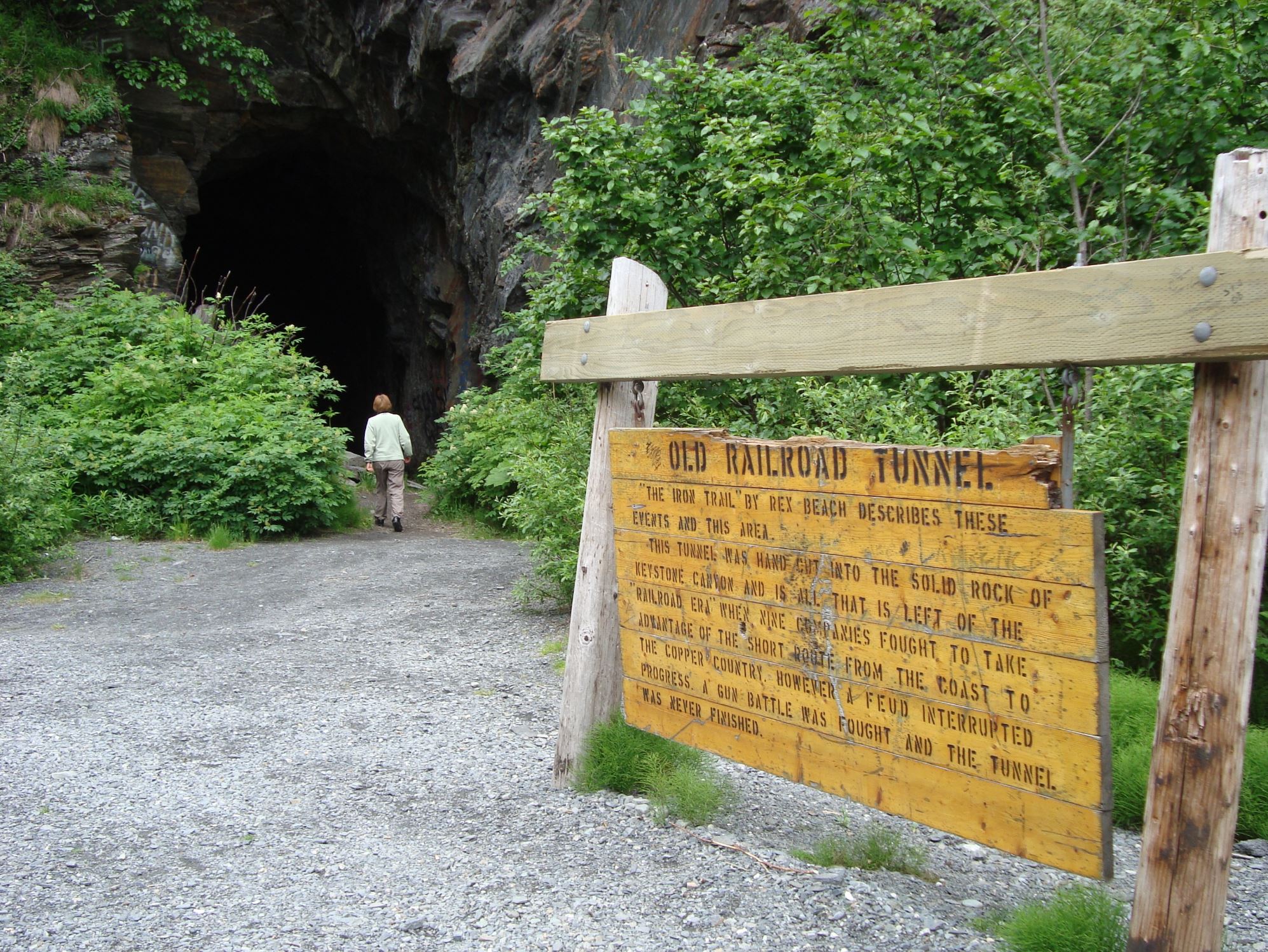
There was an attempt to build a railroad line to Valdez in 1905. The goal was to connect Port Valdez to the rich copper mines at Kennecott (in what is now Wrangell-St. Elias National Park). There was a race between rival factions. Rail lines were started and two tunnels through rock mountains were in progress when a shootout took place in 1907. This ended progress and the rail was never finished.
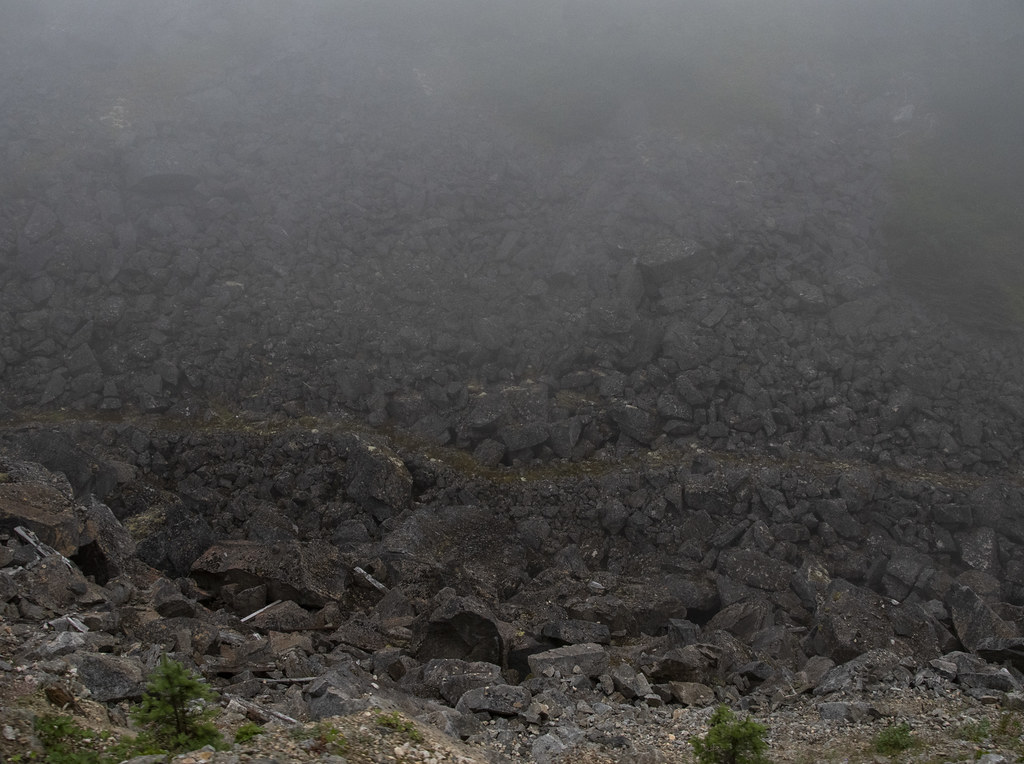
We were not able to stop at the tunnel pulloff. This is a screenshot of a photo I found online by Barry Swackhamer, June 24, 2010.

Jumping ahead about 50 years from the 1900 gold rush to around 1950 the trail over the Valdez Glacier has been replaced with a road through “Keystone Canyon” called the Richardson Highway.

Day 72_Valdez MuseumsIMG_1608
Day 72_Valdez MuseumsIMG_1610
Day 72_Valdez MuseumsIMG_1609

Advertisement with happy smiling travelers.

Day 72_Valdez MuseumsIMG_1611

The reality. Valdez-Fairbanks Stage Line was not a easy experience.

Then came the 1964 earthquake

Day 72_Valdez MuseumsIMG_1636
Day 72_Valdez MuseumsIMG_1637
Day 72_Valdez MuseumsIMG_1640
Day 72_Valdez MuseumsIMG_1638
Day 72_Valdez MuseumsIMG_1615
Day 72_Valdez MuseumsIMG_1614
Day 72_Valdez MuseumsIMG_1633
Day 72_Valdez MuseumsIMG_1632

We saw this grove of dead spruce trees in Resurrection Bay on our Lu-Lu Belle boat trip. Resurrection Bay got it’s name from a historic storm incident in 1792. Alexander Baranov, the first governor of Russian America was exploring the Gulf of Alaska when a storm forced his crew to find refuge in a Bay of Prince William Sound. The storm cleared on Easter Sunday so they named it Resurrection Bay.

Day 72_Valdez MuseumsIMG_1613
Day 72_Valdez MuseumsIMG_1639

March 24th, 1989 is the infamous of the infamous Exxon Valdez 11 million gallon oil spill.

Day 72_Valdez MuseumsIMG_1616

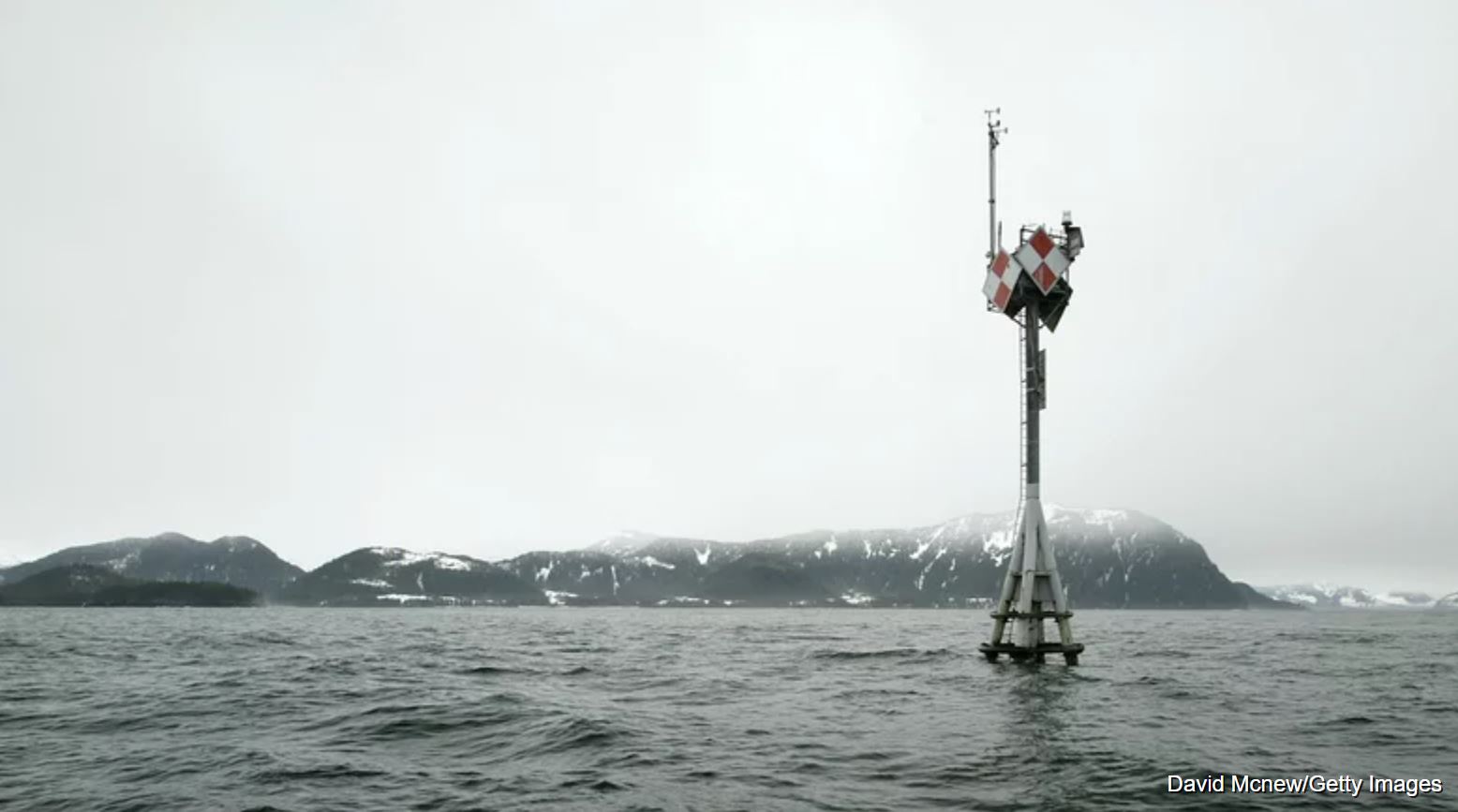
Screenshot of Bligh Reef Light from internet. This marks the area that the single hull supertanker Exxon Valdez went aground on the rocks of Bligh Reef. Subsequent reforms now require oil tankers to have double hulls among other precautions. We saw this from a very long way away so it was nice to find a photo up closer.

Day 72_Valdez MuseumsIMG_1641

Ship at an oil loading station near the Old Town Valdez Museum.

Day 72_Valdez MuseumsIMG_1642

View across Port Valdez of Alyeska Oil Terminal. This is the storage/shipping facility at the southern end of the Alaskan Pipeline.

Day 72_Valdez MuseumsIMG_1597

About this time we started to think about reservations at the places we had planned for our trip home after the Alaska Trip. We had planned to go to Cascades National Park in Washington and places out west. We decided that was not prudent with all the wild fires and smoke. Started thinking about alternatives but that could wait a while so more on that in a later post.

Valdez – Salmon Hatchery – August 10 & 11

Alaskan Adventure: Day 71 and 72. Mike and Amy drove us to the “Solomon Gulch Fish Hatchery” which is across Valdez Bay, opposite of the town of Valdez. They said “You have to see this!” it was an incredible place to visit!

Day 71_Valdez HatcheryUntitled_Panorama-1

View from fish hatchery, across the bay of Port Valdez. The dark areas are not gravel. That is Salmon (mostly Pink Salmon).

Video at hatchery looking across Port Valdez toward the town of Valdez.

Day 71_Valdez Hatchery_DAD3847

Looking “up’ Port Valdez toward…

Day 71_Valdez Hatchery_DAD3863

Lots of Sea Gulls enjoying the feast.

Video

Day 71_Valdez Hatchery_DAD3867

Fighting over fish scraps

Day 71_Valdez Hatchery_DAD3599

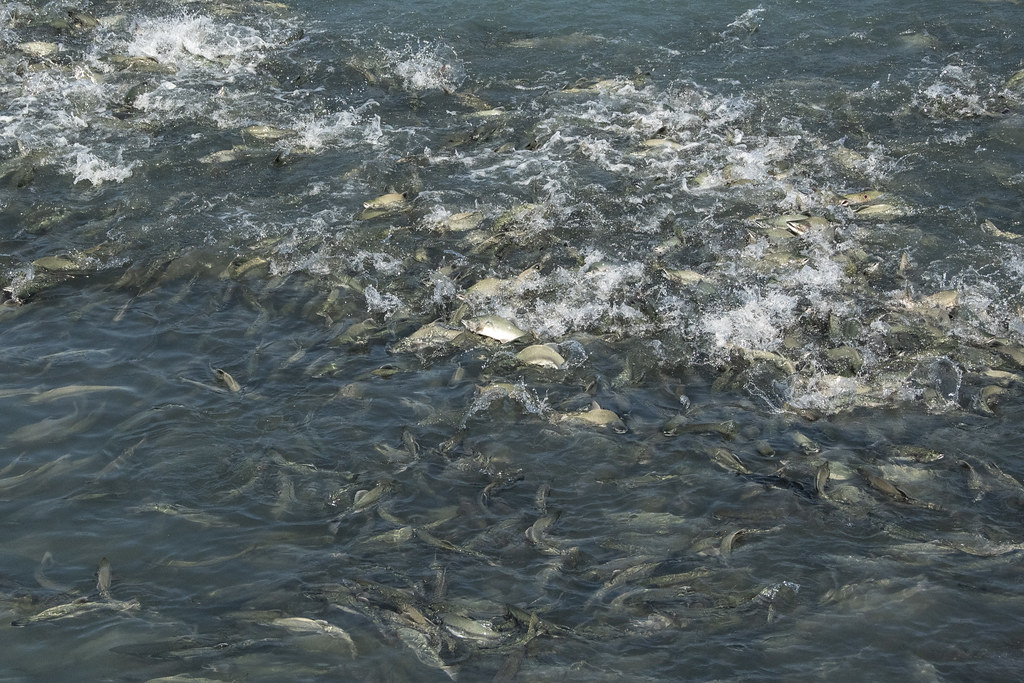
So many Salmon. The old saying “you could walk across on the backs of the salmon” is easy to understand.

Day 71_Valdez Hatchery_DAD3835
Day 71_Valdez Hatchery_DAD3626

Video

Day 71_Valdez Hatchery_DAD3625
Day 71_Valdez Hatchery_DAD3592
Day 71_Valdez Hatchery_DAD3596
Day 71_Valdez Hatchery_DAD3618

Sea Lions have no problem grabbing up salmon

Day 71_Valdez Hatchery_DAD3757
Day 71_Valdez Hatchery_DAD3746

Salmon get very excited when Sea Lions are around!

Day 71_Valdez HatcheryIMG_1659
Day 71_Valdez Hatchery_DAD3886
Day 71_Valdez Hatchery_DAD3642

Very fat, contented Sea Lions barely moved.
Day 71_Valdez Hatchery_DAD3843

Fireweed along the edge of the water.

Day 71_Valdez HatcheryIMG_1577

Salmon information at the hatchery

Day 71_Valdez HatcheryIMG_1578

We were told that most of the salmon we saw were Pink Salmon

Day 71_Valdez HatcheryIMG_1594
Day 71_Valdez HatcheryIMG_1593

We stopped at “Old Town” on our way back to camp. The old town is gone except some old foundations. A few buildings were relocated to the new town location after the 1964 earthquake. The rest of the town was intentionally burned down.

Day 71_Valdez Hatchery_DAD3917

US Forest Service Office. It was cool to see salmon coming up the natural mountain stream and spawning in the gravel.

Day 71_Valdez Hatchery_DAD3923

Video

Day 71_Valdez Hatchery_DAD3903

Salmon in the stream spawning in a gravel nest

Day 71_Valdez Hatchery_DAD3920

Very far away but that is a Bald Eagle flying over the trees.

That wraps up August 10th. August 11th was a day we visited several places around town including some museums. That will be a separate post.
Skipping ahead to the evening of August 11th, we had a “going away farewell gathering” for Kris & Jamie who needed to leave the group a little early to head home for medical reasons. It was a chilly evening but a good time to realize how we had all become good friends in our travels together. Most of the group is in the pic below.

Day 72 Valdez EveningIMG_1650

RV Group pic.

Day 72 Valdez EveningIMG_1647

Scenery from our campsite.

After the Farewell Party, me and Mike Z. went back to the hatchery to hopefully see some bears. No bears again.

Day 72 Valdez Evening_DAD4052

Tide was very low so most of the Sea Lions were a little off-shore waiting for tide to come back in,

Day 72 Valdez Evening_DAD4060
Day 72 Valdez Evening_DAD4062

This eager Sea Lion was close to shore and enjoying easy pickings

Day 72 Valdez Evening_DAD3965
Day 72 Valdez Evening_DAD4048

So many salmon they were just on top of each other

Day 72 Valdez Evening_DAD4002

Some were jumping up the falls to get to the stream coming down out of the mountains

Video

Day 72 Valdez Evening_DAD4022

Soaring Sea Gulls everywhere

Day 71_Valdez HatcheryIMG_1590

Video

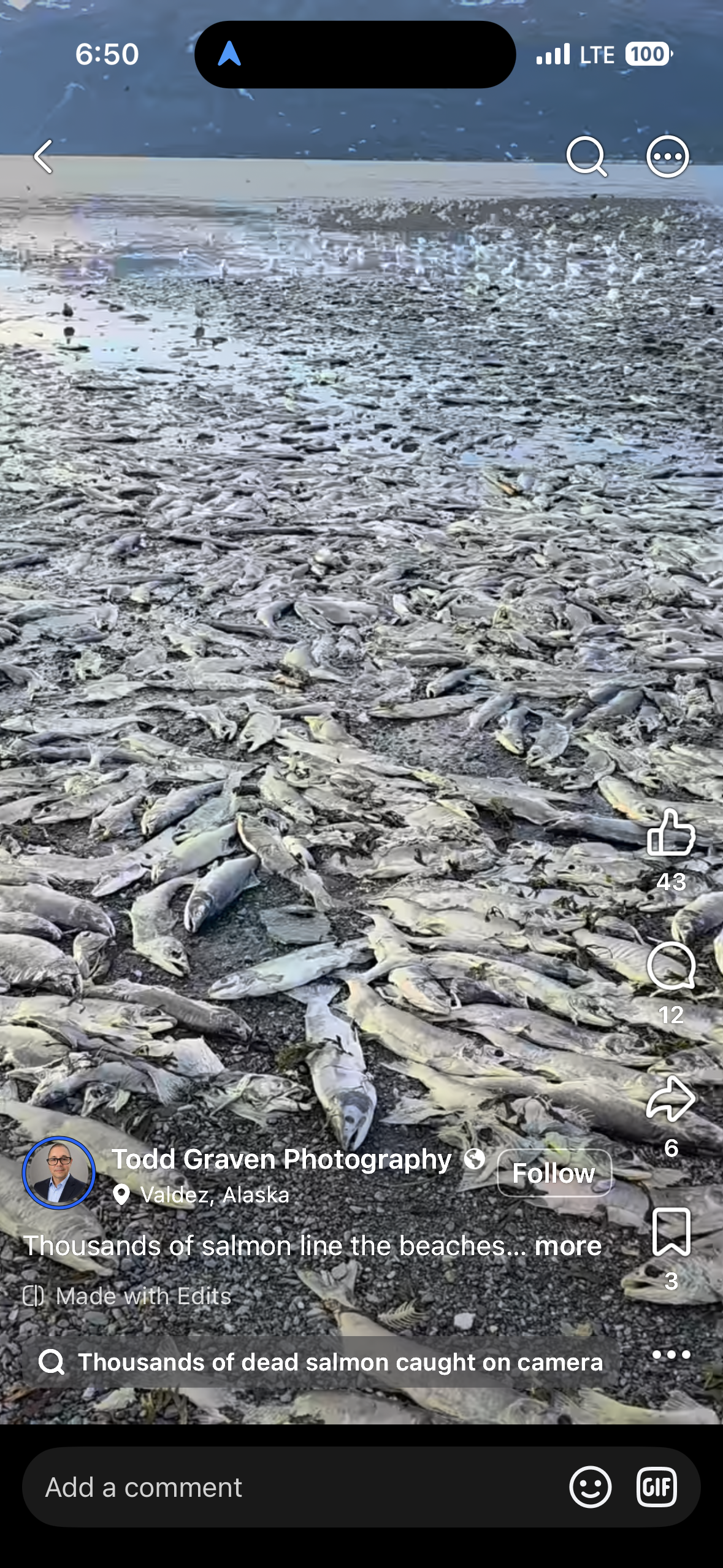
We were in Valdez at just the right time; lots of salmon returning to spawn. Just a week later most of them were dead… this screenshot from facebook makes me glad we were not there. It smelled pretty fishy when we were there. I imagine it would be really smelly now.

Day 71_Valdez HatcheryIMG_1662

We waited around awhile hoping to see bears come down out of the adjacent wooded mountains. No bears but a beautiful dusk.

Day 72 Valdez Evening_DAD4028

The Valdez welcome sign at dusk. We leave Valdez and head for Tok tomorrow morning.

Valdez – Lu Lu Belle Boat Tour – August 9

Alaskan Adventure: Day 70. Our group set sail at 11:00am on the “Limousine of Valdez” piloted by Captain Fred. The day began overcast but gradually cleared and became sunny but not much warmer. We got back to dock around 8:00pm. It was really cold standing out on deck taking pictures but there was so much beauty to see!

Day 70 - Valdez Lu-Lu Belle Boat iPhoneIMG_1564

Valdez Harbor

Day 70 Valdez Lu-Lu Belle Boat_DAD2043

Waiting to board the Lu-Lu Belle

Day 70 Valdez Lu-Lu Belle BoatUntitled_Panorama-1

The graceful Lu-Lu Belle

Day 70 - Valdez Lu-Lu Belle Boat iPhoneIMG_1496

Valdez Harbor from the back of the Lu-Lu Belle

Day 70 Valdez Lu-Lu Belle Boat_DAD2055
Day 70 Valdez Lu-Lu Belle Boat_DAD2054

Was it the Sea Gulls laughing or Bernadette and Joe?

Day 70 Valdez Lu-Lu Belle Boat_DAD2063

Tug boats in Port Valdez.

Day 70 - Valdez Lu-Lu Belle Boat iPhoneIMG_1497

Setting out we saw the huge oil storage tanks on the opposite side of Valdez Bay

Day 70 - Valdez Lu-Lu Belle Boat iPhoneIMG_1498

View heading out toward Prince Edward Sound

Day 70 - Valdez Lu-Lu Belle Boat_DAD2109
Day 70 Valdez Lu-Lu Belle Boat_DAD2113

Inquisitive Sea Otters

Day 70 Valdez Lu-Lu Belle Boat_DAD2130
Day 70 Valdez Lu-Lu Belle Boat_DAD2181

More Sea Otters

Day 70 Valdez Lu-Lu Belle Boat_DAD2191
Day 70 - Valdez Lu-Lu Belle BoatUntitled_Panorama-10

Beautiful Scenery

Day 70 Valdez Lu-Lu Belle Boat_DAD2266
Day 70 Valdez Lu-Lu Belle Boat_DAD2188

Bald Eagle and lots of waterfalls

Day 70 - Valdez Lu-Lu Belle Boat_DAD2192
Day 70 Valdez Lu-Lu Belle Boat_DAD2206

I think this is a Pigeon Guillemot (same family as Puffins)

Day 70 - Valdez Lu-Lu Belle Boat_DAD2301

The Captain pointed out the tower marking the location that the Exxon Valdez ran aground and broke open spilling oil into Prince William Sound on March 24, 1989. That is an iceberg to the right of the tower. Both are very big but we were very far away. There is a closer picture of the tower in the next post (August 11th).

Day 70 Valdez Lu-Lu Belle Boat_DAD2817

Bunches of colorful Puffins

Day 70 Valdez Lu-Lu Belle Boat_DAD2746
Day 70 Valdez Lu-Lu Belle Boat_DAD3042
Day 70 Valdez Lu-Lu Belle Boat_DAD3026
Day 70 Valdez Lu-Lu Belle Boat_DAD3079

Captain Fred maneuvered the front of the boat into a shallow cave for us to get very close to this Puffin

Day 70 - Valdez Lu-Lu Belle Boat_DAD2694

Another Sea Otter

Day 70 - Valdez Lu-Lu Belle BoatUntitled_Panorama-12
Day 70 - Valdez Lu-Lu Belle Boat_DAD3087

So many Sea Lions!

Sea Lions were pretty vocal about our boat being in their space

Day 70 - Valdez Lu-Lu Belle Boat_DAD2688
Day 70 - Valdez Lu-Lu Belle Boat_DAD2759
Day 70 Valdez Lu-Lu Belle Boat_DAD2865

Lots of Sea Lions with Pups

Day 70 Valdez Lu-Lu Belle Boat_DAD2952
Day 70 Valdez Lu-Lu Belle Boat_DAD2945
Day 70 Valdez Lu-Lu Belle Boat_DAD2973

More Sea Lions

Day 70 Valdez Lu-Lu Belle Boat_DAD2499
Day 70 - Valdez Lu-Lu Belle Boat_DAD2392

Humpback Whales. The Lu-Lu Belle boat came up on two sleeping whales.

Day 70 Valdez Lu-Lu Belle Boat_DAD2442

Humpback Whale Blowhole

Day 70 - Valdez Lu-Lu Belle Boat_DAD2511

Humpback Whale Fluke

Day 70 Valdez Lu-Lu Belle Boat_DAD2621
Day 70 Valdez Lu-Lu Belle Boat_DAD2542
Day 70 Valdez Lu-Lu Belle Boat_DAD2543

Lots of Whale Tails

Day 70 Valdez Lu-Lu Belle Boat_DAD3249
Day 70 Valdez Lu-Lu Belle Boat_DAD3250
Day 70 Valdez Lu-Lu Belle Boat_DAD3251
Day 70 Valdez Lu-Lu Belle Boat_DAD3252
Day 70 Valdez Lu-Lu Belle Boat_DAD3253
Day 70 Valdez Lu-Lu Belle Boat_DAD3255
Day 70 Valdez Lu-Lu Belle Boat_DAD3257
Day 70 Valdez Lu-Lu Belle Boat_DAD3197

We started seeing little icebergs floating around as we neared the mouth of Columbia Bay

Day 70 - Valdez Lu-Lu Belle Boat_DAD2551

Majestic mountains behind entrance to Columbia Bay

Day 70 - Valdez Lu-Lu Belle Boat iPhoneIMG_1533

Icebergs covered Columbia Glacier Bay.

Day 70 Valdez Lu-Lu Belle Boat_DAD3317

The chunks of colorful ice got bigger and bigger

Day 70 Valdez Lu-Lu Belle Boat_DAD3550

Some of the largest icebergs are resting on the bottom instead of floating.

Day 70 Valdez Lu-Lu Belle BoatUntitled_Panorama-2
Day 70 Valdez Lu-Lu Belle BoatUntitled_Panorama-3
Day 70 - Valdez Lu-Lu Belle Boat iPhoneIMG_1536
Day 70 - Valdez Lu-Lu Belle Boat iPhoneIMG_1559
Day 70 - Valdez Lu-Lu Belle Boat iPhoneIMG_1563
Day 70 Valdez Lu-Lu Belle Boat_DAD3497
Day 70 - Valdez Lu-Lu Belle Boat iPhoneIMG_1537
Day 70 Valdez Lu-Lu Belle BoatUntitled_Panorama-4

The face of Colombia Glacier is 8 miles away. The field of icebergs was too dense to get any closer.

Day 70 Valdez Lu-Lu Belle BoatUntitled_Panorama-5

Columbia Glacier is the largest tidewater glacier in Alaska. It is retreating very rapidly. Captain Fred attributes the rapid rate to the 1964 earthquake settling areas that allowed meltwater to flow underneath the ice.

Day 70 Valdez Lu-Lu Belle Boat_DAD3396

The face of Columbia Glacier. Doesn’t seem terribly impressive but the ice face varies between 200′ to 300′ high. (a 20-30 story building).

Day 70 Valdez Lu-Lu Belle BoatUntitled_Panorama-6
Day 70 - Valdez Lu-Lu Belle Boat iPhoneIMG_1547

Because we couldn’t get close to the main branch of Columbia Glacier we visited this west branch of the Columbia Glacier which is not calving as much so more approachable

Day 70 - Valdez Lu-Lu Belle Boat iPhoneIMG_1553

Glacier Tourists

Day 70 Valdez Lu-Lu Belle Boat_DAD3540

We saw whale spouts off in the distance as we were returning from the glaciers

Day 70 - Valdez Lu-Lu Belle Boat iPhoneIMG_1563
Day 70 Valdez Lu-Lu Belle BoatUntitled_Panorama-8
Day 70 Valdez Lu-Lu Belle BoatUntitled_Panorama-7

Beautiful ice sculptures

Day 70 Valdez Lu-Lu Belle Boat_DAD3560

The Lady in the rock (face profile).

This post ends with several videos of the boat moving into Columbia Bay; navigating slowly between the biggest icebergs and bumping aside the smaller ones with ‘clunks’. The videos may seem boring but it was pretty wild being on the boat and wondering how he would miss the next one straight ahead. A bit of the ‘Titanic’ movie came to mind more than once.

Favorite Bible verse for today: Romans 11: 33-36

Oh, the depth of the riches, both of the wisdom and knowledge of God! How unsearchable are His judgments and unfathomable His ways! For who has known the mind of the Lord, or who became His counselor? Or who has first given to Him, that it would be paid back to him? For from Him, and through Him, and to Him are all things. To Him be the glory forever. Amen.

Palmer to Glennallen to Valdez – August 7 & 8

Alaskan Adventure: Days 68 & 69. We traveled from Palmer to Glennallen and stayed one night at “Ranch House RV Camping” with a dinner at the historic Glennallen Roadhouse. The next morning we made an Amazingly beautiful drive from Palmer to Valdez.

Day 68 Palmer to Glennallen_DAD1755
Day 68 Palmer to Glennallen_DAD1722

Mountain scenery as we headed out of Palmer.

Day 68 Palmer to GlennallenUntitled_Panorama-2
Day 68 Palmer to Glennallen_DAD1748

Colorful Sheep Mountain area.

Day 68_Palmer to GlennallenIMG_1269
Day 68_Palmer to GlennallenIMG_1453

On our drive from Palmer to Glennallen we stopped for lunch (and cinnamon rolls) at “Sheep Mountain Lodge Restaurant” We sat underneath this enormous moose head. A good reminder that a moose is a really big animal. We joke about all the moose warning signs along the roads because we sure don’t see very many. Would like to see more but glad to not hit one.

Day 68 Palmer to GlennallenUntitled_Panorama-1

Matanuska Glacier.

Day 68 Palmer to Glennallen2026_0807_152818_021806F

Road construction. Who needs guardrails.

Day 68 Palmer to Glennallen2026_0807_154651_021827F

Waiting, waiting, waiting…

Day 68 Palmer to Glennallen2026_0807_155752_021840F

There was a very big, deep, hole in the road to go past which was a bit exciting as the RV leaned left in the grass to get past.

Day 68 Palmer to Glennallen2026_0807_182627_022000F

This is an Alaskan Highway. Sometimes OK, other times really patched up. What would be a bad county road in most States qualifies as a State Highway here.

Day 68 Palmer to Glennallen2026_0807_183522_022012F

Dashcam shot as we pulled into Glennallen Historic Roadhouse RV Park. The blurred tree in the middle is from a bug splat on the windshield.

Day 68 Palmer to Glennallen_DAD1760

Entry to Roadhouse for a Roadhouse Dinner.

Day 68_Palmer to GlennallenIMG_1458

Inside the Historic Roadhouse. Built in the late 1940’s.

Day 68 Palmer to Glennallen_DAD1759
Day 68 Palmer to Glennallen_DAD1756

We were told this is a 1941 International Harvester delivery truck. One of only three made available for purchase by civilians. All others went to the War effort.

Day 68_Palmer to GlennallenIMG_1461

Another International Harvester truck.

Day 68_Palmer to GlennallenIMG_1459

Story goes that these were two timepieces nailed to the cabin wall when one of the builders got tired of being asked “what time is it?”

Day 68 Palmer to Glennallen_DAD1729
Day 68 Palmer to Glennallen_DAD1764

Flowers at the RV park. Quote below was clipped from a weather news account that day.

Heat Advisory

Had to chuckle when we saw Alaska was issuing heat advisories for areas we were traveling. We finally had a few days with sunshine. Family members back home in Indiana, Missouri, and Kansas were dealing with scorching 90’s and 100’s while we were wearing fleece jackets. It was hot in the sun but 60’s and 70’s with a cool breeze in the shade was great here in Alaska.

Our first stop after leaving Glennallen was Wrangell-St Elias National Park Visitor Center.

Glennallen to ValdezIMG_1470

The volcanic end of the mountain range (foreground on topo map) is the “Wrangell” portion. The mountain range extending into the background is the “St Elias” portion. That portion is not volcanic. It is uplifted as the Pacific Tectonic Plate subducts beneath it.

Glennallen to ValdezIMG_1467

Wrangell-St Elias National Park and Preserve is the Largest National Park in the United States (20,000+ square miles). It has the largest collection of glaciers on the North American Continent and many of the highest mountain peaks. In combination with other adjacent parks it is part of the 2nd largest contiguous protected land area in the World (Wrangell-St Elias NP/Glacier Bay NP/Tatshenshini-Alsek World Heritage Site/Kluane NP)

Day 69_Glennallen to ValdezUntitled_Panorama-1

Normally Photoshop does a great job of stitching together multiple photos. In this case it didn’t but it shows how many of the photos in this blog are created, especially when I’m using the long telephoto lens.

Day 69_Glennallen to ValdezUntitled_Panorama-4

This pic of Mount Drum, taken from the overlook near the Visitors Center is made of 3 photos stitched together in Photoshop.

Day 69_Glennallen to Valdez_DAD1806
Day 69_Glennallen to Valdez_DAD1804
Day 69_Glennallen to Valdez_DAD1784
Day 69_Glennallen to ValdezUntitled_Panorama-3
Day 69_Glennallen to Valdez_DAD1809
Day 69_Glennallen to ValdezUntitled_Panorama-5
Glennallen to Valdez2026_0808_174608_022205F

Dashcam shot of Worthington Glacier near the top of Thompson Pass.

Day 69_Glennallen to Valdez_DAD1911

Worthington Glacier

Day 69_Glennallen to Valdez_DAD1948
Day 69_Glennallen to ValdezUntitled_Panorama-6

Ice details of Worthington Glacier.

Day 69_Glennallen to Valdez_DAD1949
Day 69_Glennallen to Valdez_DAD1950

Not a volcano but looks like one coming down from Thompson Pass on the Richardson Highway into Valdez.

Day 69_Glennallen to Valdez_DAD1895
Day 69_Glennallen to Valdez_DAD1905

Deep gorge at Tsaina River bridge: “Devil’s Elbow”

Day 69_Glennallen to Valdez_DAD1893

The mountains just soar upwards.

Day 69_Glennallen to Valdez_DAD1910

Fireweed flowers continue to move up the stem toward the top. When flowers reach the top it is said to indicate summer is coming to an end and winter snow is six weeks away.

Glennallen to Valdez2026_0808_182001_022245F

Continuing toward Valdez, we entered “Keystone Canyon”. A beautiful part of the drive that made Valdez much easier to access. Previous to the Army Corps of Engineers cutting a road through Keystone Canyon the access to Valdez was over Valdez Glacier, which would be tough in an RV… This is a dashcam shot going through Keystone Canyon.

Glennallen to ValdezUntitled_Panorama-8

Keystone Canyon had two big waterfalls right along the highway. This one is Bridal Veil Falls. 600′ high and the tallest roadside waterfall in Alaska.

Glennallen to ValdezIMG_1479
Day 69_Glennallen to ValdezUntitled_Panorama-7

A bunch of pics stitched together.

Day 69_Glennallen to Valdez_DAD1966
Day 69_Glennallen to Valdez_DAD2003

Horsetail Falls. 330′ high.

Day 69_Glennallen to Valdez_DAD2025
Day 69_Glennallen to Valdez_DAD2035

Colorful Rocks by the falls.

Dashcam video pulling into Valdez RV Park.

Glennallen to ValdezIMG_1489
Glennallen to ValdezIMG_1490

Our campsite at Valdez has a beautiful view of mountains and tidal flat that empties and fills twice a day.

Glennallen to ValdezIMG_1491

This was sobering as our campsite is about 4′ above the tide. The “old townsite” of Valdez was abandoned after the 1964 earthquake. More on that in a Valdez Museum post to come later.

Tomorrow we will go on an all day boat tour on the “Lu-Lu Belle” boat. That will be a separate post.

Favorite Bible verse today: Acts 26:22-23

So, having obtained help from God, I stand to this day testifying both to small and great, stating nothing but what the Prophets and Moses said was going to take place, as to whether the Christ was to suffer, and whether, as first from the resurrection of the dead, He would proclaim light both to the Jewish people and to the Gentiles.

Seward & Palmer – August 1-6

Alaskan Adventure: Days 62-67 This is a ‘catch-up’ post that includes lots of miscellaneous pics between the big activities that have been separate posts. There is so much to see and do it is hard to keep up.

The Bear Viewing and Halibut Fishing trips in Homer are separate posts. Here are a few miscellaneous pics of Homer before we travel on to Seward. Homer is located in Kachemak Bay with the unique feature of a “spit”. The 4 1/2 mile long spit has an odd history. Seems there is disagreement about how it formed but most say it is the remnant of a 14,000 year old glacial moraine (where the glacier stopped moving forward and dumped a bunch of rock and gravel). The 1964 Good Friday Alaska earthquake dropped the spit 4′-6′. The town got it’s name from Homer Pennock in 1896. The spit was a popular hippie hangout in the 60’s which must have been exciting during the earthquake. The earthquake was the 2nd biggest quake (9.2) ever recorded on earth.

Day 62_Seward_Exit GlacierIMG_1337
Day 62_Seward_Exit GlacierIMG_1331

Our campsite at Homer was not down on the spit but up on a high bluff overlooking the southwest end of the Kenai Mountains Peninsula.

Day 62_Seward_Exit GlacierIMG_1333
Day 62_Seward_Exit GlacierIMG_1334

Price lists for shipping or purchasing fresh caught fish in Homer.

On Saturday, August 1st we traveled from Homer to Seward. It was really foggy when we left but gradually cleared up by mid-morning.

Day 62_Seward_Exit GlacierUntitled_Panorama-1

Mount Redoubt (10,200′) is a massive stratovolcano across the Cook Inlet from Anchor Point area. The cloud layer was very low on the water the day we traveled back north from Homer. Some claim the road out to the end of the Homer spit is the furthest west highway in North America. Others claim that designation is the highway near Anchor Point. We drove them both.

Day 62_Seward_Exit GlacierIMG_1338

We stopped here near Cooper Landing at Gwin’s Lodge Roadhouse for breakfast and (the last for the day) really gooey cinnamon bun. Pat and Helen Gwin used hand peeled local spruce logs to build the log roadhouse which opened in 1952. The “Sterling Highway” we were traveling runs adjacent to the beautiful turquoise blue Kenai River. Wish I had some photos of the river but the road here is narrow and winding; there was no good place to pull off. Salmon were starting to run up the river to Kenai Lake so there were fisherman starting to crowd the bridge access areas to the river.
Here’s a link to a cool overhead photo of the river: https://alaskariveradventures.wordpress.com/wp-content/uploads/2013/02/cooper-landing-from-above.jpg

Day 62_Seward_Exit GlacierUntitled_Panorama-2

Arriving in Seward we went with Mike and Amy to see Exit Glacier. Got the Kenai Fjords National Park stamp. The road to Exit Glacier is not plowed so is only open (to cars) in summer. It is the only road into Kenai Fjords National Park.

Day 62_Seward_Exit GlacierIMG_1339

Exit Glacier is just one of many glaciers from the huge Harding Icefield. We would see much bigger glaciers the next day on our Kenai Fjords boat trip. Kenai Fjords National Park was once entirely covered in ice. It is still half covered in ice and has several tidewater glaciers. The largest tidewater glacier in the National Park is Aialik.

Day 62_Seward_Exit GlacierIMG_1340
Day 62_Seward_Exit GlacierIMG_1346
Day 62_Seward_Exit GlacierIMG_1343
Day 62_Seward_Exit GlacierIMG_1348

After visiting Exit Glacier we went to see the Seward Marina and the Seward Mariners’ Memorial.

Day 62_Seward_Exit GlacierIMG_1351

Line of fishing boats coming in at the end of the day. Cruise ship in the background is turning around after backing out of Seward harbor.

Day 62_Seward_Exit Glacier_DAD0587

Sea gulls were everywhere!

Day 62_Seward_Exit Glacier_DAD0632

When we got back to our campsite there was this Bald Eagle sitting beside a huge nest.

On Sunday, August 2nd we did a boat tour from Seward Marina with Kenai Fjords Tours. See this post: https://dadartphotography.com/2026/08/02/seward-kenai-fjords-national-park-august-2/

On Monday, August 3rd we visited the Alaska Sealife Center in Seward. Here are some pics from that visit.

Day 64_Seward_Alaska Sealife CenterIMG_1417

Old poster was a reminder that our RV road trip to Alaska was largely enabled by military efforts following Pearl Harbor.

Day 64_Seward_Alaska Sealife CenterIMG_1404

Alaska region geography, especially names of adjacent Oceans and Seas.

Day 64_Seward_Alaska Sealife CenterIMG_1405

Little closer showing major mountain ranges.

Day 64_Seward_Alaska Sealife CenterIMG_1406
Day 64_Seward_Alaska Sealife CenterIMG_1407

More maps, just because they are interesting.

Day 64_Seward_Alaska Sealife CenterIMG_1413

Surprising to me that 10% of earths landmass is covered with glaciers and 75% of all freshwater on earth is locked up in glaciers!

Day 64_Seward_Alaska Sealife CenterIMG_1414

I had no idea they used their fins to wedge themselves into rock crevices.

Salmon swimming. There were several tanks where you could see the progression from little to large salmon.

Day 64_Seward_Alaska Sealife CenterIMG_1412

Salmon stuff wraps up the visit to Alaska Sealife Center.

On Tuesday, August 4th we went Gold Panning on Kenai Lake at “Prospector John’s”. This was an added activity replacing the cancelled Jet Boat trip originally scheduled back in Talkeetna that got flooded out.

Day 65_Cooper Landing_Prospecter JohnIMG_1434
Day 65_Cooper Landing_Prospecter JohnIMG_1431

Prospector John’s headquarters is this rustic gift shop. I was greatly puzzled by the advertisement of “Jerky Jewelry”.

Day 65_Cooper Landing_Prospecter JohnIMG_1422

Beautiful blue Kenai Lake and towering mountains. There was a good deal of apprehension about this excursion but the experience was great. We had a few sprinkles but did not get poured on. The bugs were not bad, and we all found gold and some small garnets.

Day 65_Cooper Landing_Prospecter JohnIMG_1421
Day 65_Cooper Landing_Prospecter JohnIMG_1420

Curtis was our tour guide and boat pilot as we pounded across the lake. Amy and Becky smiling was a good sign.

Day 65_Cooper Landing_Prospecter JohnIMG_1425
Day 65_Cooper Landing_Prospecter JohnIMG_1429

Gold prospectors at Prospector John’s claim on Devil’s Canyon.

Becky got some personal tips and help from Prospector John himself! Prospector John was featured on Discovery Channels Gold Mining show “Devils Canyon”.

Gold and GarnettIMG_1585

No idea what it’s worth but here’s our gold flakes and little bits of garnets

Our Wagon Master – Joe, finding gold.

Day 65_Cooper Landing_Prospecter JohnIMG_1441

On our way back to Seward we stopped at a salmon viewing area near a salmon hatchery. This was the first time we have seen salmon. Hoping to see more before the end of the trip.

On Wednesday, August 5th we left Seward and traveled to Palmer. There is only one road route so we retraced our way through the rough road in Moose Pass and headed back toward Anchorage. This was the 6th time we traveled the road along the mud flats of Turnagain Arm. Passing through Anchorage we got cheap gas at Costco ($4.47 vs $5.45 in Seward) and groceries at Walmart before continuing north to Palmer. Our group activity at Palmer was to visit a “Musk Ox Farm”.

Day 65_Cooper Landing_Prospecter JohnIMG_1442

The morning we left Seward was wet and overcast but the mountain was beautiful. The big clump in the tree is a bald eagles nest.

The “Barn” (Visitor Center/Gift Shop) at the Musk Ox Farm. Photo by group member Melinda.

Day 66_Palmer_Musk Ox Farm_DAD1679

I didn’t know that I needed to visit a Musk Ox Farm but I learned a few interesting things. Musk Ox are “farmed” not for meat but for their extremely warm under-fur. Each spring the under-fur is harvested only once by combing. They get 5-9 pounds per animal. Musk Ox are not “domesticated” and they do not like to be touched. They are prey animals whose only defense is grunting and head butting. They were eradicated from North America. These are descendants of some Musk Ox reintroduced from Iceland.

The under-fir is called qiviut (pronounced kiv-ee-yute). It is a very rare, ultra-soft, and lightweight wool that is roughly eight times warmer than sheep’s wool and finer than cashmere. A small skein of yarn in the gift shop was $150.

Day 66_Palmer_Musk Ox Farm_DAD1683

Part of our group getting the story and trying not to scare the big fluffy cow.

Day 66_Palmer_Musk Ox Farm_DAD1704
Day 66_Palmer_Musk Ox Farm_DAD1697

Big Black Raven visited on our walk around the farm. Posed with snow capped mountains.

Day 66_Palmer_Musk Ox Farm_DAD1701
Day 66_Palmer_Musk Ox Farm_DAD1719
Day 68_Palmer to GlennallenIMG_2307

We all got to hold a very heavy Musk Ox skull.

Day 66_Palmer_Musk Ox FarmIMG_1443

Benedict with the wary eye. They remove the sharp horn ends so they don’t injure each other.

Day 66_Palmer_Musk Ox FarmIMG_1445
Day 66_Palmer_Musk Ox FarmIMG_1444

Beautiful example of God’s creative design enabling these unique animals to thrive in extreme cold.

Day 66_Palmer_Musk Ox FarmIMG_1446

Awesome steel sculpture.

That’s it for miscellaneous pics on days from Homer to Palmer. Next stop is Glennallen for one night then on to Valdez for three nights.

Favorite Bible verse lately: Romans 4:21-25

…and being fully assured that what God had promised, He was able also to perform. Therefore it was also credited to him as righteousness. Now not for his sake only was it written that it was credited to him, but for our sake also, to whom it will be credited, to us who believe in Him who raised Jesus our Lord from the dead, He who was delivered over because of our wrongdoings, and was raised because of our justification.